Chinese Culture
The Basic Logic of Zi Wei Dou Shu: Palaces, Stars, and Timing
A structured beginner guide to the twelve palaces, symbolic stars, chart combinations, major cycles, and annual layers in Zi Wei Dou Shu.
- Best for
- Beginners who want to understand how a Zi Wei Dou Shu chart is organized
- May change
- Schools, chart-calculation methods, terminology, and interpretation methods
Start with palaces and stars
The basic logic of Zi Wei Dou Shu comes from the relationship between palaces and symbolic stars. A simple beginner analogy is:
The palace is the room. The star is the guest.
The same guest behaves differently in a bedroom, office, court, or battlefield. In the same way, a symbolic star may take on a different meaning depending on its palace and surrounding pattern.
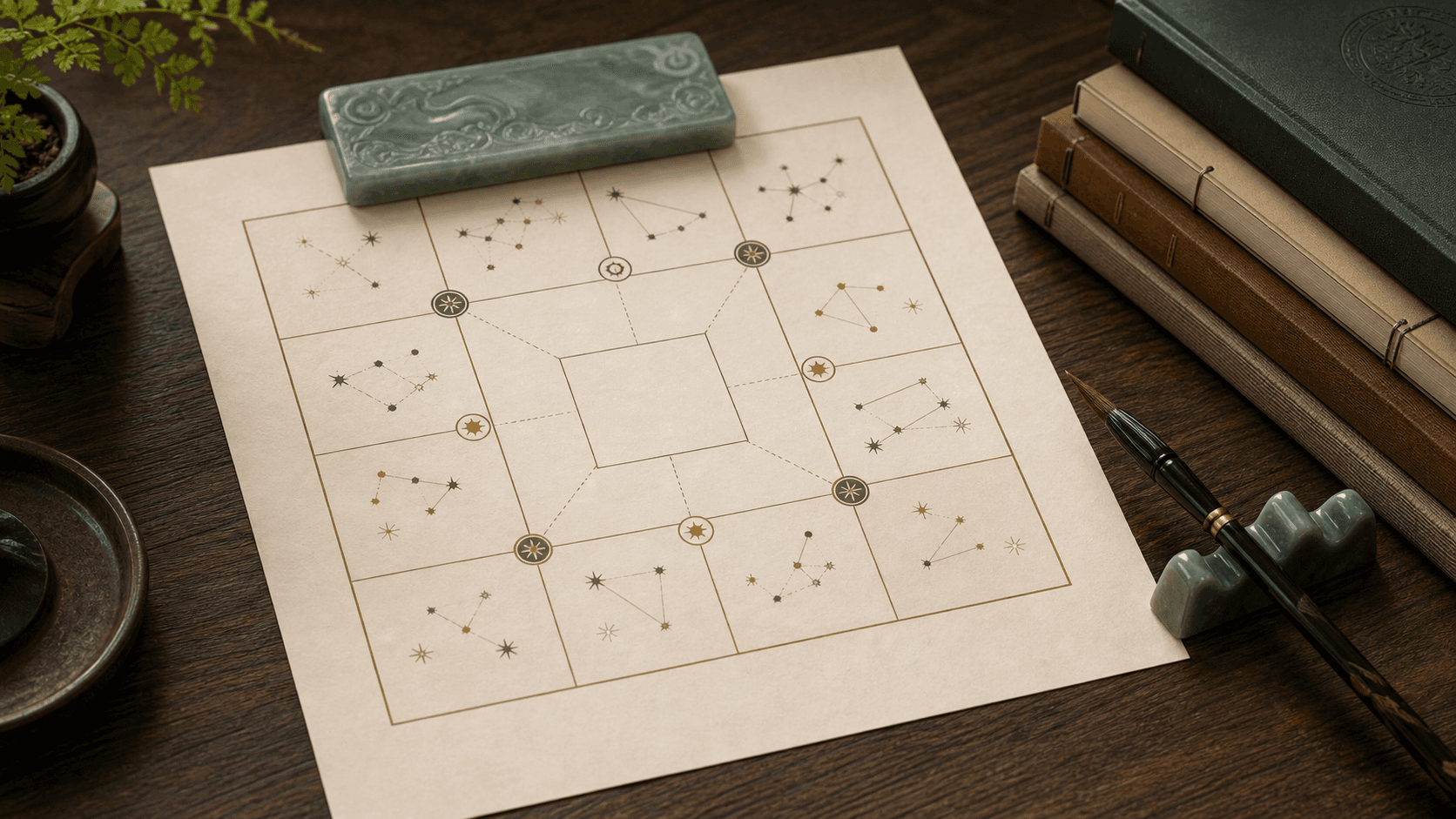
The twelve-palace map
The chart uses twelve palaces to organize recurring life themes:
- Life Palace: core self and life pattern.
- Siblings Palace: sibling ties and peer support.
- Spouse Palace: partnership dynamics.
- Children Palace: children, students, and legacy themes.
- Wealth Palace: money and resources.
- Health Palace: health tendencies and stress patterns.
- Travel Palace: travel, relocation, and the outside world.
- Friends Palace: collaborators, helpers, and social circles.
- Career Palace: work, responsibility, and public role.
- Property Palace: home, stability, and living environment.
- Fortune Palace: inner life, values, and emotional comfort.
- Parents Palace: parents, elders, mentors, and institutions.
Symbolic stars are characters, not astronomy
The stars in Zi Wei Dou Shu are symbolic names, not physical stars in the modern astronomical sense. Some are compared to rulers, strategists, treasuries, generals, officials, protectors, or agents of change.
For example, Zi Wei is traditionally treated as a central ruling star. Tian Ji is often associated with strategy and movement. Wu Qu is connected with action and material resources. Tian Fu is associated with storage, stability, and management.
These are starting points, not one-line verdicts.
Why combinations matter
No star should be judged alone. Traditional interpretation considers which stars are together, which palace they occupy, what supports or challenges them, and what timing layer is active.
This is why the system can feel layered. It does not say, "one star equals one result." It asks how several symbols meet within a specific life theme and time period.
Timing layers
Zi Wei Dou Shu also includes timing. Two common beginner terms are:
- Da Xian: a larger life phase, commonly treated as a ten-year cycle.
- Liu Nian: an annual layer for one year.
If the original chart is the blueprint, the major cycle is the current chapter, and the annual layer is the current scene.
A cultural map, not a command
For global readers, the most useful first step is to understand the structure. You do not need to accept every interpretation to appreciate how the chart connects time, relationships, family, social role, inner life, and personal choice.
Sources and reference checks
- Traditional Zi Wei Dou Shu reference materials
- Beginner guide prepared from the Zi Wei Dou Shu draft pack
Conversation
Questions and comments
Share a question, correction, or reading note. Most comments appear automatically. Some are held briefly for review.
Need a private reply? Email chiyaoyaoya@gmail.com.
Loading comments...