China Travel Basics
How to Pay in China as a Foreigner
A beginner-friendly guide to Alipay, WeChat Pay, international cards, RMB cash, and backup plans for a first trip to China.
- Best for
- Travelers setting up payments before arrival
- May change
- App onboarding steps, supported cards, transaction limits, identity verification, merchant acceptance, and bank policies
Quick answer
Prepare mobile payment before arrival, but do not depend on a single method. For most short trips, a sensible setup is Alipay, WeChat Pay, a physical international bank card, and a modest amount of RMB cash.
China's official payment guidance explicitly covers bank cards, mobile payment, cash, bank accounts, and e-CNY. Cash remains a legitimate payment method. Mobile payment is simply the most convenient everyday option in many situations.
Set up Alipay and WeChat Pay before your flight
The Chinese government's 2025 English-language guide says foreign visitors can download WeChat, Alipay, or UnionPay apps, register with a foreign or Chinese mobile phone number, and follow the prompts to bind a bank card.
The same guide lists cards carrying Visa, Mastercard, UnionPay, American Express, JCB, Diners Club, and Discover logos. Actual support can still depend on the card, issuer, account, transaction, and current app rules.
Older travel guides may tell you to start with Alipay `Tour Pass`. Treat that as outdated advice. Current official payment guidance emphasizes binding an eligible international card directly to Alipay or WeChat Pay. Follow the current in-app flow rather than an old screenshot.
A practical setup order
- Download Alipay and WeChat from your phone's official app store.
- Register with the phone number you expect to use during your trip.
- Complete any identity-verification prompts carefully.
- Bind an eligible international card.
- Keep your bank's verification method available.
- Check the current fees, limits, and in-app instructions.
You do not need to turn setup into a weekend project. One working app plus a backup is a good start.
Alipay and WeChat Pay should not be treated as replacements for a Chinese bank account. Features such as person-to-person transfers, wallet balance functions, and red packets may be unavailable or limited when you are using an international card. Prepare them primarily for paying merchants.
How everyday mobile payment works
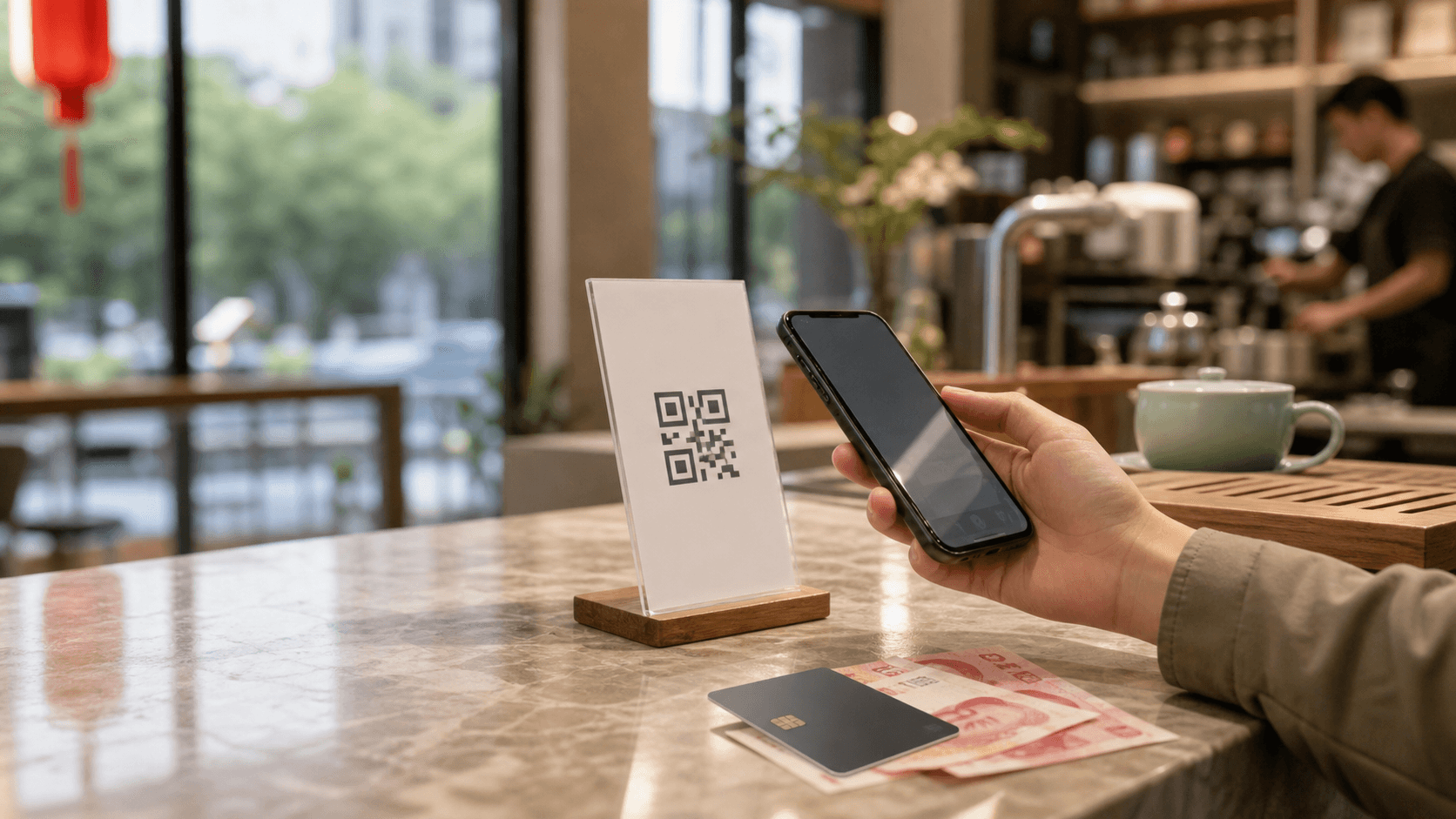
At many shops and restaurants, you will either scan the merchant's QR code or show your own payment code for the cashier to scan. Follow the amount shown in the app and confirm it before approving payment.
The exact flow varies by merchant and app. For your first test, choose a small ordinary purchase such as water or a snack. If one app does not work, try your backup instead of debugging in a queue.
China's official payment guide says that transactions of RMB 200 or less are exempt from the additional service fee when an international card is bound to Alipay or WeChat Pay. A service fee of 3 percent applies to transactions above RMB 200. Your own card issuer may also charge foreign-transaction or cash-withdrawal fees, so check before travel.
Keep RMB cash
Cash is useful when a phone battery dies, signal is weak, an app is unavailable, or a small purchase becomes awkward. The official 2025 guide says overseas visitors can exchange foreign currency for RMB cash before arrival, use exchange services marked with an Exchange logo, or withdraw RMB with international cards at ATMs where supported.
ATM support and fees vary by bank and card. You do not need a large bundle of cash for an ordinary city trip. A modest backup amount and some smaller notes are more practical.
Bring a physical card too
Card acceptance has been improved at important locations such as airports, hotels, major commercial areas, and scenic spots, but acceptance is not identical everywhere. A physical card is particularly useful for hotel deposits, larger purchases, emergencies, and cash withdrawal. Ask your hotel how a deposit or pre-authorization will be handled and when it is expected to be released.
Do not assume that a small restaurant or street-side shop will take a foreign card directly at the counter.
A simple three-layer payment plan
- First choice: mobile payment through Alipay or WeChat Pay.
- Second choice: a physical international bank card.
- Backup: RMB cash.
Keep your backup separate from your main wallet. Also keep your phone charged.
Common mistakes
- Arriving with only one payment app and no cash.
- Waiting until airport arrival to register every app.
- Assuming every international card will bind successfully.
- Depending entirely on a foreign card at small merchants.
- Forgetting that bank fraud checks or phone-number verification can interrupt a payment.
- Assuming an international card can top up every wallet function or send money to another person.
- Forgetting that a payment above RMB 200 may carry the app service fee.
- Carrying large amounts of cash when a modest backup would be enough.
Before you travel
- Read the current Guide to Payment Services in China.
- Check your card issuer's travel and verification settings.
- Set up Alipay, WeChat Pay, or both.
- Bring a physical card and a little RMB cash.
- Save your hotel's address offline in case you need help.
For the broader preparation sequence, return to the First-Time China Travel Checklist.
Next step
Turn this guide into a practical pre-departure plan
Use the first-time China travel pack to prepare apps, payment backups, transport, hotels, arrival basics, and Mandarin survival phrases in one place.
Sources and reference checks
- https://english.www.gov.cn/services/liveinchina/
- https://english.www.gov.cn/news/202403/15/content_WS65f3bcb1c6d0868f4e8e51b5.html
- https://english.www.gov.cn/news/202408/22/content_WS66c71b3ec6d0868f4e8ea2b1.html
- https://english.www.gov.cn/AssetsZi/A_Guide_to_Working_and_Living_in_China_as_Business_Expatriates_2025.pdf
Conversation
Questions and comments
Share a question, correction, or reading note. Most comments appear automatically. Some are held briefly for review.
Need a private reply? Email chiyaoyaoya@gmail.com.
Loading comments...