Chinese Culture
What Is Jianghu?
A beginner-friendly cultural guide to jianghu: its origins, development, modern meaning, and role in Chinese dramas.
- Best for
- C-drama fans and Chinese culture beginners
- May change
- Drama examples, genre usage, and subtitle translations
To understand jianghu, do not begin with swords. Begin with people: people outside the center of power, people bound by promises, people carrying favors, grudges, names, and choices.
A quick definition
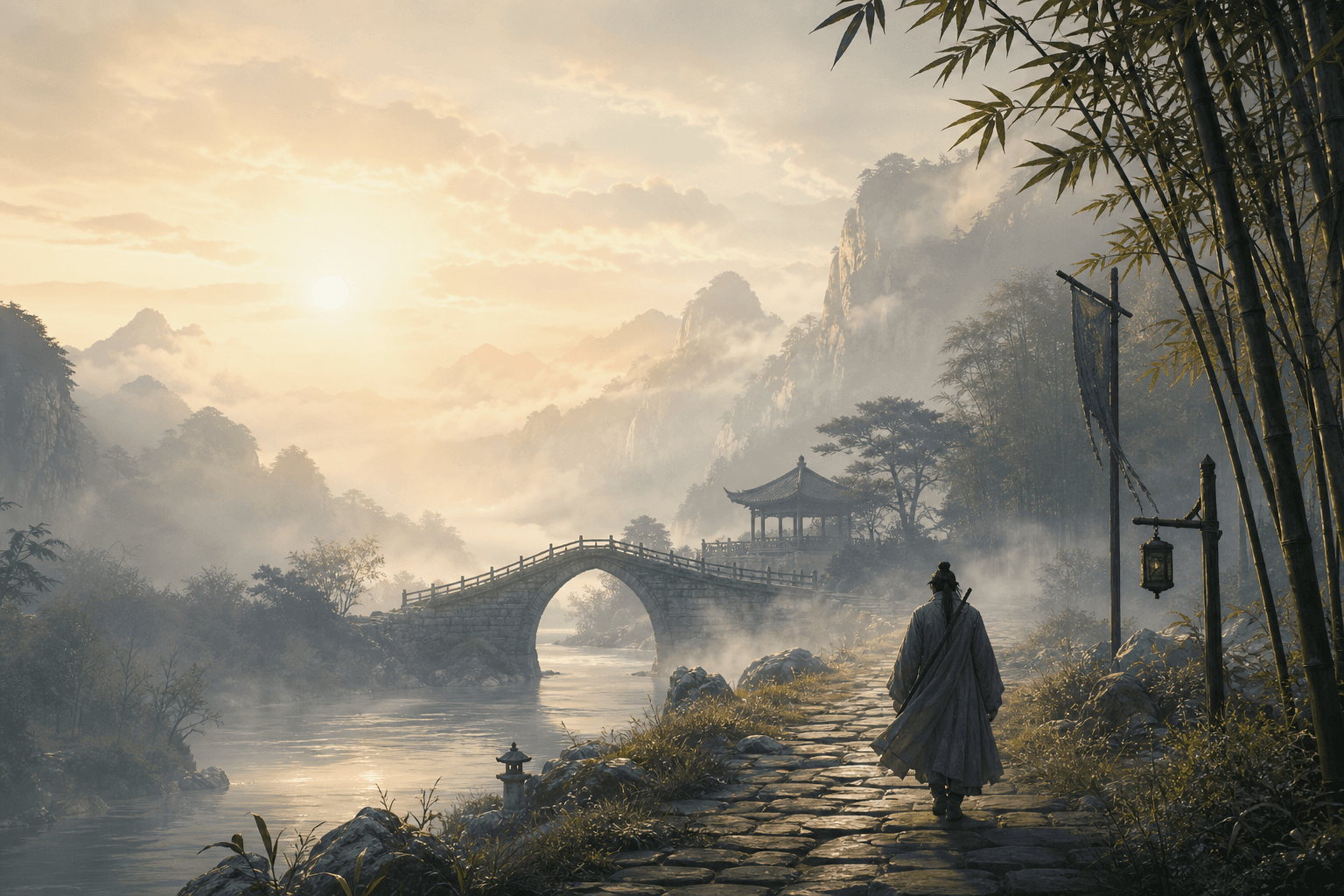
Jianghu is one of those Chinese cultural words that looks simple until you try to translate it. Literally, the two characters suggest "rivers and lakes." In stories, however, jianghu usually means a social world outside ordinary official life: the world of wandering heroes, martial artists, sects, sworn friendships, rival schools, secret debts, and personal justice.
For English-speaking viewers, subtitles often translate jianghu as "the martial world." That is useful, but incomplete. Jianghu is not only a place where people fight. It is a way of imagining society: informal, emotional, mobile, dangerous, and full of rules that are rarely written down.
If the palace is the world of rank, titles, and state power, jianghu is the world of reputation, loyalty, skill, and consequence. One has official documents. The other has promises made under moonlight, which is frankly a much riskier filing system.
Where did the idea come from?
The word jianghu originally evokes a broad natural space: rivers, lakes, and the open world beyond the court, the capital, and fixed institutions. Over time, this physical image became a cultural image. To be in jianghu was not simply to stand beside water. It suggested being away from the center of official order, living among travelers, wanderers, craftsmen, performers, monks, martial artists, merchants, and people whose lives did not fit neatly into courtly or bureaucratic categories.
The deeper cultural root is tied to the figure of xia, often translated as a chivalrous hero or knight-errant. In early Chinese cultural memory, xia figures were associated with courage, martial ability, loyalty, keeping promises, repaying kindness, and helping others in danger. They could be admired because they acted when formal power failed. They could also be troubling because their personal sense of justice did not always obey official law.
That tension is important. Jianghu was never just a romantic playground. It carried a question that still gives Chinese storytelling much of its electricity: when rules, relationships, and justice do not agree with one another, what should a person do?
How jianghu developed
As Chinese literature developed, the idea of xia and the world around xia became richer. Stories about heroic action, revenge, loyalty, disguise, apprenticeship, and moral testing gradually formed a recognizable imaginative space. Later, wuxia fiction gave this space a stronger genre shape.
Wuxia literally combines wu, meaning martial or military, and xia, the chivalrous hero. In wuxia stories, jianghu became the larger world where martial heroes live and act. It could include famous sects, hidden manuals, wandering swordsmen, family grudges, moral teachers, secret poisons, sworn siblings, and rankings of skill. Some details are highly fictional, of course. Please do not plan your China trip around finding a cliffside cave with a lost kung fu manual. The subway is much more reliable.
By the twentieth century, modern wuxia novels, films, television dramas, comics, and games helped make jianghu a familiar cultural landscape. Audiences learned to recognize its emotional grammar: a rescued life creates a debt, a teacher's death demands an answer, a sect's reputation can shape a person's fate, and a promise made early in the story may return many episodes later with the force of thunder.
This is why jianghu feels both ancient and modern. It draws from long cultural traditions, but every new novel, drama, and game can rebuild it in a slightly different way.
What jianghu means today
Today, jianghu still strongly belongs to wuxia and historical fantasy storytelling. But the word also appears in broader everyday language. People may use jianghu metaphorically to describe a complicated social world, a professional circle, an industry network, or a place where experience, connections, favors, and unwritten rules matter.
In that modern sense, jianghu can mean "the world out there," especially a world that is not fully controlled by formal rules. It can sound romantic, humorous, weary, or cynical depending on the context. Someone might say a person has "entered jianghu" to suggest they have stepped into real social complexity and now must learn how people actually behave.
This wider meaning helps explain why the word carries so much feeling. Jianghu is not only about swords. It is about what happens when human relationships become a system of their own.
What jianghu represents in Chinese dramas
In Chinese dramas, jianghu often represents freedom from official order. Characters in jianghu can travel, hide their identities, choose their teachers, form sworn bonds, challenge powerful people, and live according to personal codes. That freedom is part of the appeal.
But jianghu also represents danger. Without stable official protection, reputation matters intensely. A rumor can ruin someone. A favor can become a chain. A sect can feel like family, but it can also demand obedience. A heroic promise can save one life and destroy another. In good dramas, jianghu is never only cool costumes and elegant sword moves. It is a pressure cooker for moral choices.
Jianghu also allows dramas to explore the distance between public order and private feeling. Court dramas often ask, "What does power require?" Jianghu stories often ask, "What does loyalty require?" When the two worlds meet, the drama gets especially interesting. A character may have to choose between law and friendship, family duty and personal justice, revenge and mercy, survival and reputation.
Example: Nirvana in Fire
Nirvana in Fire is not a simple wuxia drama, but it is a useful example because it shows how jianghu can overlap with court politics. Mei Changsu is connected to the Jiangzuo Alliance, a powerful organization outside the imperial court. His influence does not come from an official title at first. It comes from intelligence, networks, reputation, hidden history, and loyalty.
This kind of setup helps foreign viewers see jianghu as more than sword fighting. Jianghu can be an alternative social order. It has its own information channels, moral bonds, and forms of authority. When that world enters the palace, it brings a different kind of power with it.
Example: wuxia mystery dramas
Many wuxia mystery dramas use jianghu as a moving map of cases, sects, old grudges, and hidden identities. A hero may travel from one place to another, meeting doctors, monks, martial artists, innkeepers, former rivals, and people who know one small part of a much larger story.
In these dramas, jianghu works almost like a living archive. Every person has a past. Every sect has a reputation. Every object may carry memory. A sword is not just a weapon; it may belong to a teacher, a family, or a betrayal. A small inn is not just a place to sleep; it may be where rumors, alliances, and ambushes quietly gather over dinner.
That is why new viewers sometimes feel lost. Jianghu stories often expect you to track not only the plot, but also relationships, debts, titles, schools, and moral expectations. Once you understand that, the fog starts to clear.
How to watch jianghu stories
When a drama uses jianghu, try asking a few simple questions:
- Who owes whom a favor?
- Which sect, school, clan, or sworn relationship shapes the conflict?
- What promise, injury, secret, or reputation is being protected?
- Is the character choosing official safety, personal freedom, revenge, loyalty, or moral responsibility?
These questions make jianghu easier to read. They also help you see why characters sometimes make decisions that look impractical from a modern point of view. In jianghu, practicality is not the only value. Face, honor, gratitude, teacher-disciple bonds, sworn brotherhood, and old debts can all become serious forces.
A final way to understand jianghu
The simplest way to understand jianghu is this: jianghu is not a real location on a map. It is a cultural imagination of life beyond the formal center, where people are judged by skill, reputation, loyalty, and the consequences of their choices.
Its origins reach toward older ideas of wandering, xia, personal justice, and life outside official order. Its development passed through literature, wuxia fiction, film, television, comics, and games. Today, it remains both a beloved drama world and a flexible metaphor for complicated human society.
So when a C-drama character says they are entering jianghu, the story is rarely just saying, "Now there will be fights." It is saying: welcome to a world where relationships become rules, memory becomes pressure, and freedom always comes with a price.
Sources and reference checks
- 侯天媛、郭玉成:《先秦武侠文化形成因素解析》
- 郭玉成:《武侠文化的历史传承与新时代发展》
- 韦易:《武侠文化与中国武术》
- 陆香:《中国影视剧武侠文化的翻译传播策略——以〈琅琊榜〉为引例》
- 卢思聪:《浅谈武侠电视剧中的武侠文化》
Conversation
Questions and comments
Share a question, correction, or reading note. Most comments appear automatically. Some are held briefly for review.
Need a private reply? Email chiyaoyaoya@gmail.com.
Loading comments...