Chinese Culture
Why Matching Family Background Matters in Chinese Romance Dramas
A fuller cultural guide to mendang hudui, family approval, marriage matching, class logic, Western aristocratic parallels, and romance conflicts in C-dramas.
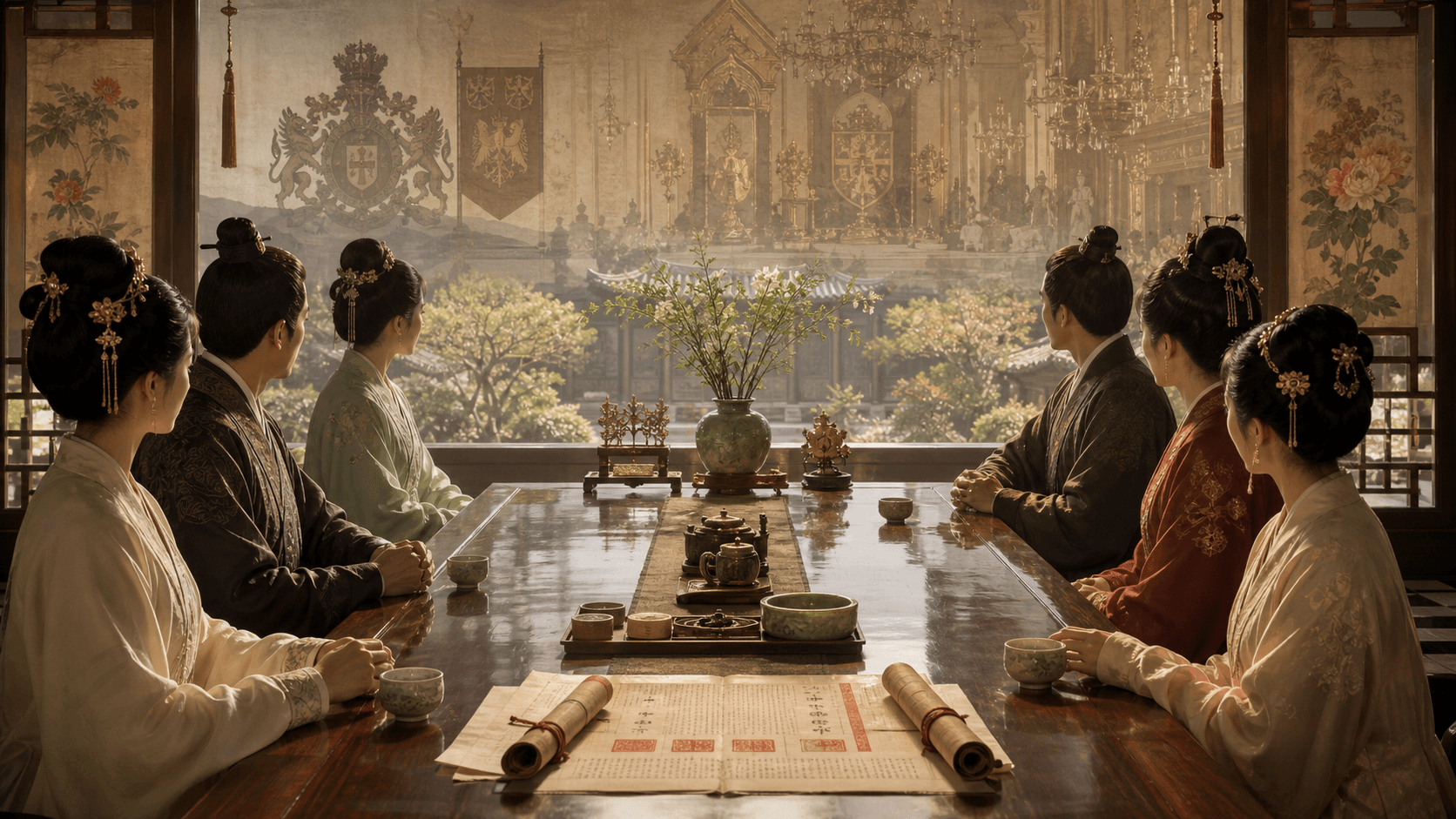
- Best for
- Romance drama viewers who wonder why family background and parental approval become major plot points
- May change
- Drama examples, modern social context, and genre usage
In many Chinese romance dramas, love begins between two people. Then family background, reputation, money, duty, housing, inheritance, and several adults with opinions walk into the room.
A quick definition
Mendang hudui is often translated as "matching family status" or "a well-matched marriage." In romance dramas, it means the two people are not judged only as individuals. Their families, class background, education, wealth, reputation, values, future obligations, and social networks may also be compared.
This is why family approval matters so often in Chinese romance dramas. The story is rarely asking only, "Do they love each other?" It is also asking, "Can this relationship survive the world around them?"
That does not mean every modern Chinese relationship works like a drama. Many couples choose freely, many parents are supportive, and many families negotiate rather than command. But C-dramas use family approval because it turns love into a social test, and social tests are very good at producing tears, arguments, and meaningful hallway pauses.
Where the idea comes from
Traditional Chinese family culture placed strong emphasis on kinship, continuity, duty, reputation, and the relationship between individual life and family order. Marriage was not only a romantic union. It could connect households, preserve lineage, organize property, strengthen alliances, produce heirs, and shape social standing.
Mendang hudui belongs to that world of family matching. Historically, the phrase suggested that two families should be socially compatible. It was not only about whether two people liked each other. It was about whether the marriage made sense within a larger family and status system.
This does not mean love was absent from Chinese culture. It means love often existed alongside other expectations. A romance could be beautiful and still face questions about family duty, social rank, economic stability, and reputation.
That tension is exactly why the theme remains useful for drama. Love is warm. Family structure is heavy. Put them together and the plot has somewhere to go.
A Western comparison: aristocratic marriage logic
For Western readers, mendang hudui becomes easier to understand when compared with aristocratic and royal marriage in European history. The systems are different, but the underlying logic is familiar: marriage was often not only about two people. It could protect property, strengthen alliances, preserve rank, produce heirs, reduce political risk, and stabilize family power.
European dynastic history gives many examples. The marriage of Ferdinand of Aragon and Isabella of Castile helped connect two major Spanish crowns. Habsburg power expanded partly through strategic marriages with heiresses and other ruling families. Noble households often treated marriage as a way to manage land, title, inheritance, diplomacy, and class position.
Chinese mendang hudui is not the same system, but the shared logic is clear. Marriage can be private emotion, but it can also be social architecture. Families ask whether the union strengthens the structure or threatens it.
This comparison helps remove the "exotic" feeling from Chinese drama plots. When a Chinese parent asks whether two families match, the emotional surface may be different from a European noble marriage negotiation, but the structural question is similar: what does this marriage do to the family system around it?
How the idea developed in drama
In costume dramas, family background often appears through clans, noble households, official families, merchant families, royal relatives, sects, or political factions. A marriage can protect a family, threaten a faction, reward loyalty, secure rank, settle conflict, or repair a relationship between powerful groups.
In palace dramas, the stakes become even higher. A marriage or consort relationship may affect succession, factional balance, maternal family power, and access to the emperor. The person entering the relationship is not treated as a private lover. They are part of a political and family network.
In modern dramas, the details change. Parents may worry about education, housing, career stability, income, hometown, divorce history, personality, family habits, public image, or whether the couple can survive practical life. The old idea does not disappear. It changes clothes.
In other words, mendang hudui moves from aristocratic household matching to modern compatibility anxiety. Same skeleton, new jacket.
What mendang hudui means today
Today, mendang hudui can sound traditional, practical, critical, or even cynical depending on context. Some people use it to mean two families are socially and economically compatible. Others use it to describe shared values, similar education, communication style, or comparable life expectations.
Modern Chinese society is diverse, and the phrase does not control everyone's choices. But family opinion can still matter because family ties often remain practically important. Parents may help with housing, childcare, wedding arrangements, money, emotional support, or social introductions. A relationship can become easier when families cooperate and harder when they strongly oppose it.
That is why the theme survives in modern romance dramas. It is not only about old tradition. It is about how private love meets real systems of support, expectation, money, reputation, and risk.
What family approval represents in C-dramas
In C-dramas, family approval often represents the social world pushing back against personal desire. The couple may understand their feelings, but they still have to ask whether the relationship can live in public.
Parents may represent care, fear, ambition, class anxiety, old wounds, reputation, control, or practical concern. A strict parent character should not be treated as a statement about all Chinese parents. It is a dramatic figure that can carry several cultural tensions at once.
Family approval also raises the stakes. If love affects only two people, the conflict may stay private. If love affects two households, the story can bring in reputation, duty, money, history, inheritance, and power. Suddenly the romance has a board meeting.
The hidden logic: risk control
One way to understand mendang hudui is to see it as risk control. Families may ask: Will this person treat our child well? Are the families compatible? Will money become a problem? Will social status create resentment? Will one person be forced to sacrifice too much? Will the marriage damage reputation? Will the couple be supported or isolated?
Some of these questions can be caring. Some can be unfair. Some can be classist. Some can be brutally practical. Drama loves this mixture because nobody is completely comfortable inside it.
This is also where the Western aristocratic comparison becomes useful. Noble marriage systems in Europe were often designed to reduce family and political risk: protect inheritance, produce legitimate heirs, secure alliances, and keep property within acceptable circles. Chinese mendang hudui works through different cultural language, but it often asks a related question: does this marriage create stability or trouble?
Costume dramas make the stakes bigger
Costume dramas intensify family approval because marriage may connect to rank, clan survival, factional politics, inheritance, or palace order. A person may not be free to marry only for love because their relationship affects many people around them.
For example, dramas about noble households or palace politics often show how women and men are evaluated through family background, virtue, alliances, public reputation, and usefulness. A marriage can protect one person while trapping another. A family may approve a match because it is beneficial, not because it is kind.
This is very close to what Western period dramas often do with noble marriage. A duke's daughter, a royal heir, or a wealthy estate owner may not be treated as a completely private person in marriage negotiations. Their marriage can affect land, title, inheritance, alliance, or family survival. Chinese costume dramas use different institutions and words, but the audience instinct is similar: love is being measured against structure.
Modern dramas change the pressure, not the pattern
Modern romance dramas usually do not involve imperial rank, but they still use family pressure. Parents may oppose a relationship because of age gaps, economic insecurity, career instability, family background, past relationships, or fear that their child will suffer.
The conflict often feels more realistic because the arguments sound practical. Can they afford a home? Are their values compatible? Will one person sacrifice too much? Is the other family trustworthy? Are the parents easy to get along with? Will the couple be exhausted by differences that romance alone cannot solve?
In modern settings, mendang hudui often becomes less about noble rank and more about education, income, city background, housing, career stability, social habits, and family expectations. The old structure may wear a business suit, carry a mortgage calculator, and ask too many questions at dinner.
Good modern dramas make the parents more than obstacles. They let viewers see why family members worry, even when their methods are unfair.
Face, reputation, and public judgment
Family approval is also connected to face and reputation. A relationship can affect how others see the household. In costume dramas, this may involve rank, clan honor, and public ritual. In modern dramas, it may involve education, career, wealth, family background, online image, or neighborhood gossip.
Face is not simply vanity. It can involve dignity, social trust, respectability, and the family's position in a wider network. That is why a romance may trigger strong reactions even when the couple themselves feel certain.
For foreign viewers, this may feel intense. But Western stories also understand reputation. Think of period dramas where a scandal damages a family name, reduces marriage prospects, or threatens inheritance. The cultural vocabulary differs, but the social fear is recognizable.
Example: arranged pressure in costume romance
In many costume dramas, a character's marriage is linked to family strategy. A daughter may be expected to marry for household benefit. A son may be pressured to protect family reputation. A couple may love each other but be separated by rank, clan conflict, or political need.
The drama is not only asking, "Do they love each other?" It is asking, "Can love survive when family duty has already written a different script?"
This is why costume romance can feel so emotionally large. The couple may not be fighting only personal misunderstanding. They may be fighting the architecture of their world.
Example: family concern in modern romance
In modern romance dramas, family approval often appears through parental concern. A parent may ask about income, housing, career plans, education, health, hometown, or family background. To overseas viewers, this can seem blunt. Inside the drama, it often signals a belief that marriage is not only emotion but long-term practical life.
The best versions of this plot allow growth on both sides. The couple learns to communicate with their families, and the family learns to see the couple as adults rather than children needing management.
The weaker versions simply turn parents into villains. The stronger versions ask a more interesting question: when love and family fear collide, can anyone learn to speak honestly?
Example: class-crossing romance
Class-crossing romance is one of the clearest uses of mendang hudui logic. A wealthy heir falls in love with someone from a modest family. A highly educated urban professional dates someone whose family expectations are very different. A noble character loves someone outside the expected rank.
These stories can be romantic because they challenge the matching system. But they can also be painful because the couple must face differences in money, manners, family obligations, social networks, and future plans. Love may begin privately, but compatibility has to survive daily life.
That is why the theme is not always conservative. Sometimes dramas use mendang hudui to defend social order. Sometimes they use it to criticize class prejudice. Sometimes they simply use it because family dinner scenes are cheaper than battle scenes and somehow just as dangerous.
How to watch family approval plots
When family approval becomes a major obstacle, ask:
- Is the family worried about love, reputation, money, rank, safety, or old history?
- Is the drama set in a world where marriage is private, social, political, or all three?
- Does the parent represent care, control, fear, ambition, class anxiety, or generational difference?
- Are the families actually incompatible, or are people using compatibility as an excuse for prejudice?
- Is the couple fighting the family, negotiating with the family, or learning to become a family of their own?
These questions help keep the plot from becoming a simple "strict parents are bad" reading. Sometimes that is the point. Often, the drama is more layered.
A final way to understand mendang hudui
Mendang hudui matters in Chinese romance dramas because love is rarely isolated from the life around it. Romance touches duty, reputation, class, care, money, housing, inheritance, family memory, and the question of what people owe to those who raised them.
The Western aristocratic comparison helps because it shows the shared human logic beneath different cultural systems. In many societies, marriage has been used to manage family interest, social risk, property, alliance, and continuity. Chinese dramas express that logic through family approval and matching background.
At its best, this theme is not anti-love. It asks a harder question: can love become strong enough, honest enough, and practical enough to live inside the world it must actually face?
Sources and reference checks
- 高学丽:《中国传统婚姻观之“门当户对”》
- 林涵:《浅析中国古代婚姻中的“门当户对”思想及其在当今的影响》
- 李桂梅:《中国近代以来家庭文化变迁的历程》
- 夏盼盼:《新时代中国家庭文化建设研究》
- 翟学伟:《中国人的人情与面子:框架、概念与关联》
- Encyclopaedia Britannica: History of Europe, dynastic rivalries and marriage alliances
- Encyclopaedia Britannica: House of Habsburg
Conversation
Questions and comments
Share a question, correction, or reading note. Most comments appear automatically. Some are held briefly for review.
Need a private reply? Email chiyaoyaoya@gmail.com.
Loading comments...