Destinations in China
Chengdu for First-Time Visitors
A first Chengdu guide for travelers who want giant pandas, Kuanzhai Alley, Jinli Street, tea, food, and a gentler city rhythm.
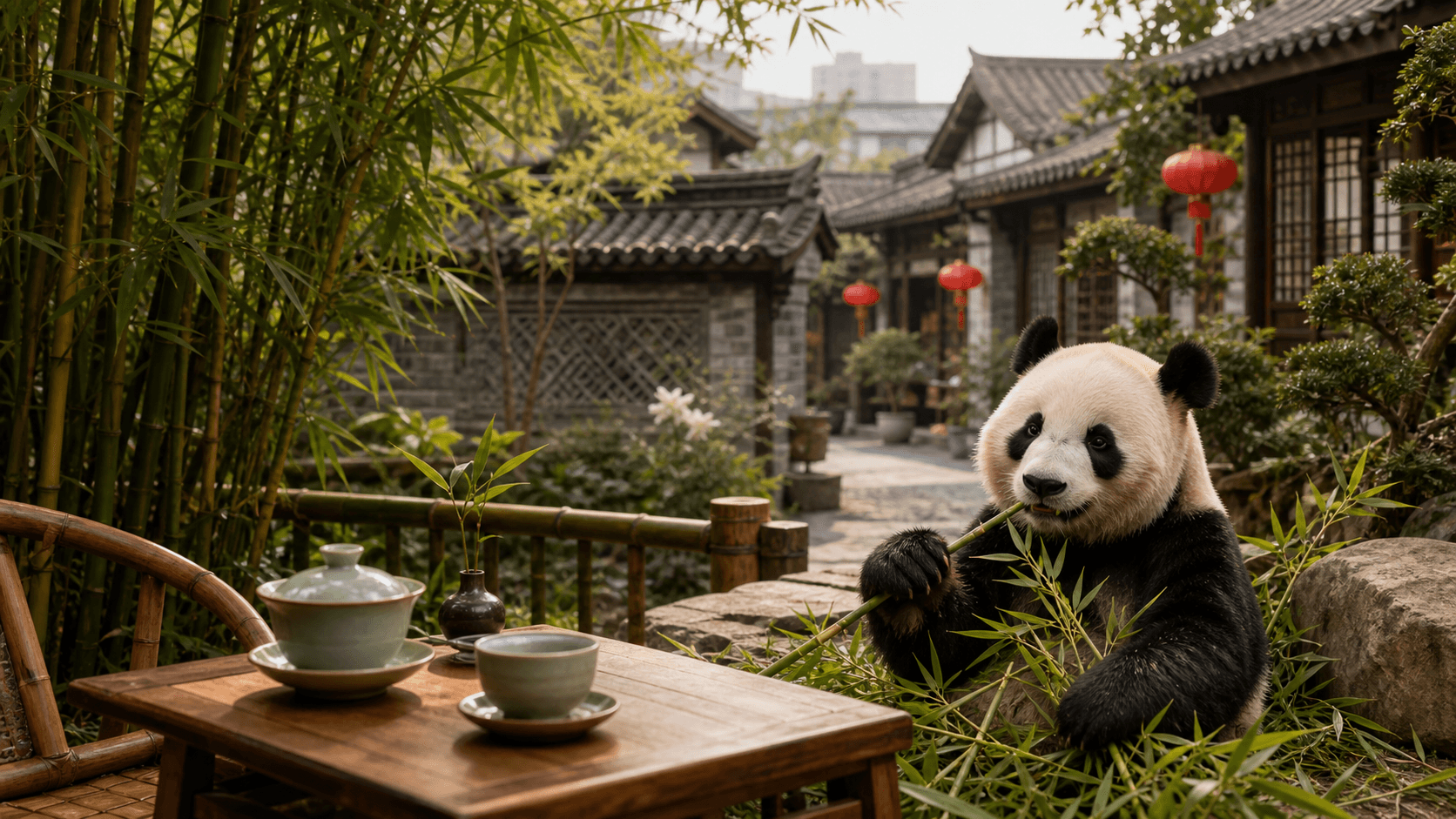
- Best for
- Travelers who want pandas, Sichuan food, neighborhood atmosphere, and a slower urban rhythm
- May change
- Panda-base ticketing, opening hours, animal visibility, seasonal events, and transport details
Why Chengdu Is Easy To Like
Chengdu is not a city that needs to be rushed. For first-time visitors, its strongest places fall into several clear groups: pandas in the north, old Chengdu lanes and temples in the city center, ancient engineering and mountain culture near Dujiangyan, Buddhist heritage around Leshan, and bigger Sichuan nature routes such as Jiuzhaigou and Huanglong. This guide lists Chengdu's most distinctive sights one by one, so you can choose your own route instead of following a fixed multi-day itinerary.
Chengdu Research Base of Giant Panda Breeding (成都大熊猫繁育研究基地)
The Chengdu Research Base of Giant Panda Breeding (成都大熊猫繁育研究基地) is located at No. 1375 Panda Avenue, Chenghua District, Chengdu (成都市成华区熊猫大道1375号), about 10 kilometers from the city center. It is one of the world's largest and most advanced artificial breeding and research institutions for giant pandas, often described as the "home of giant pandas" and a paradise for China's national treasure.
The base recreates parts of the panda's natural habitat with lakes, streams, bamboo groves, lawns, and ecological landscaping. Visitors can observe pandas of different ages at close range, from active young cubs to relaxed adult pandas eating bamboo or sunning themselves. If you are lucky, you may also see newborn panda cubs resting in the nursery area.
The base also has a Panda Theater (熊猫剧院), which presents Panda (《熊猫》), China's first panda-themed musical. The show combines theater, music, dance, and acrobatics in a roughly 70-minute performance about a panda tribe protecting its home. It is especially suitable for families.
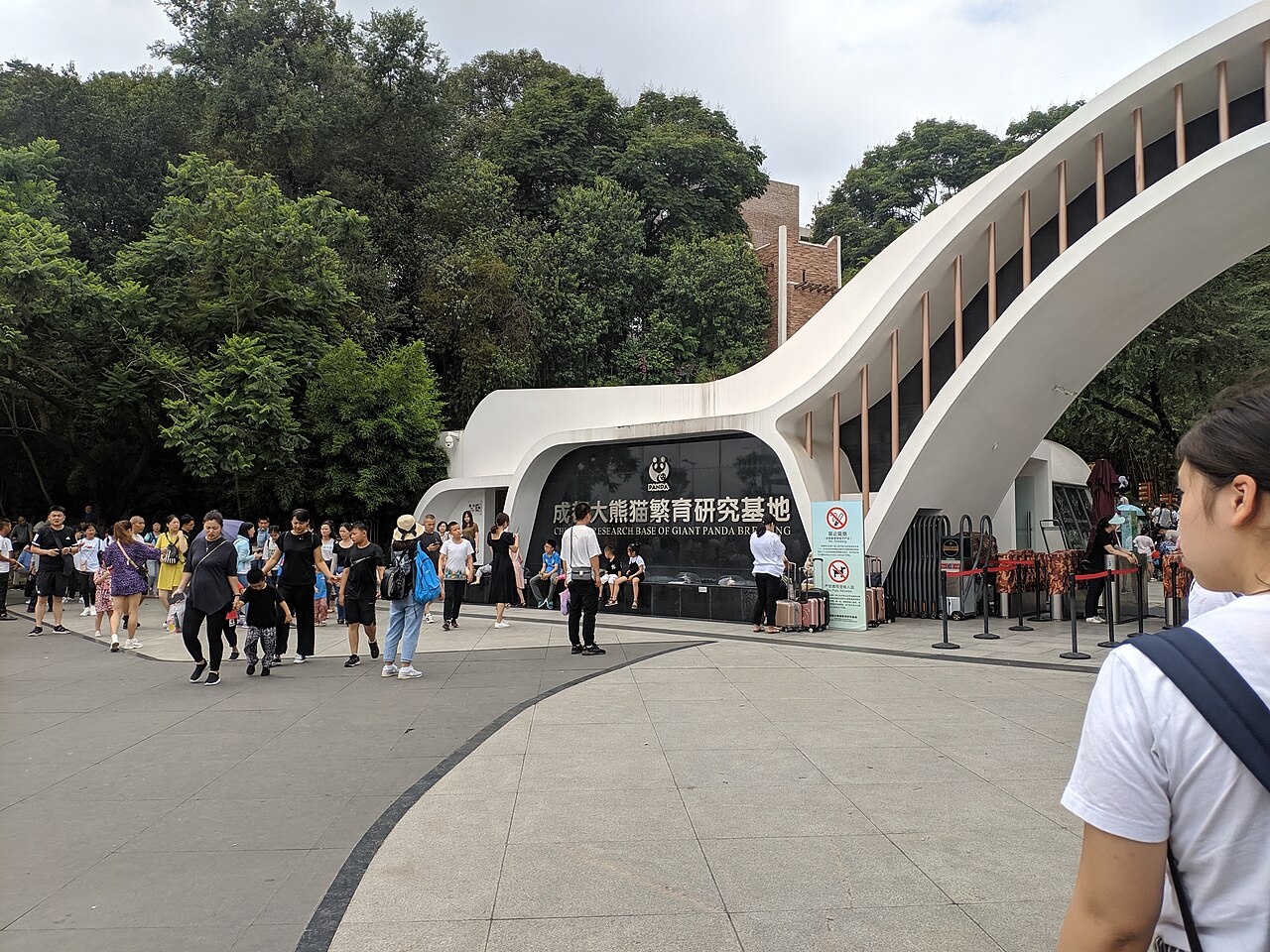
Photo: Wikimedia Commons, Jimmyshjj, open license.

Go early if pandas are your priority. Animals do not follow sightseeing schedules, and the visitor flow becomes heavier later in the day.
Central Chengdu Heritage Cluster
The following places are relatively close to one another in central Chengdu. They do not have to be visited in one rigid order, but they work well as a cultural cluster because they show different sides of old Chengdu: Three Kingdoms memory, old lanes, Taoist worship, Buddhist life, and literary history.
Chengdu Wuhou Shrine Museum (成都武侯祠博物馆)
Chengdu Wuhou Shrine Museum (成都武侯祠博物馆) is located at No. 231 Wuhouci Street, Wuhou District, Chengdu (成都市武侯区武侯祠大街231号). The museum covers about 150,000 square meters and is made up of three main areas: the Three Kingdoms historical relic zone, including Huiling Mausoleum (惠陵), Han Zhaolie Temple (汉昭烈庙), Wuhou Shrine (武侯祠), and Sanyi Temple (三义庙); the western area centered on the tomb of Liu Xiang (刘湘), a Sichuan army general of the War of Resistance; and Jinli Folk Street (锦里民俗区), which presents western Sichuan folk culture.
It is the only shrine in China jointly dedicated to Liu Bei (刘备), Zhuge Liang (诸葛亮), Guan Yu (关羽), Zhang Fei (张飞), and other Shu Han figures. For many visitors, it is also the most influential Three Kingdoms (三国) heritage museum in the world.
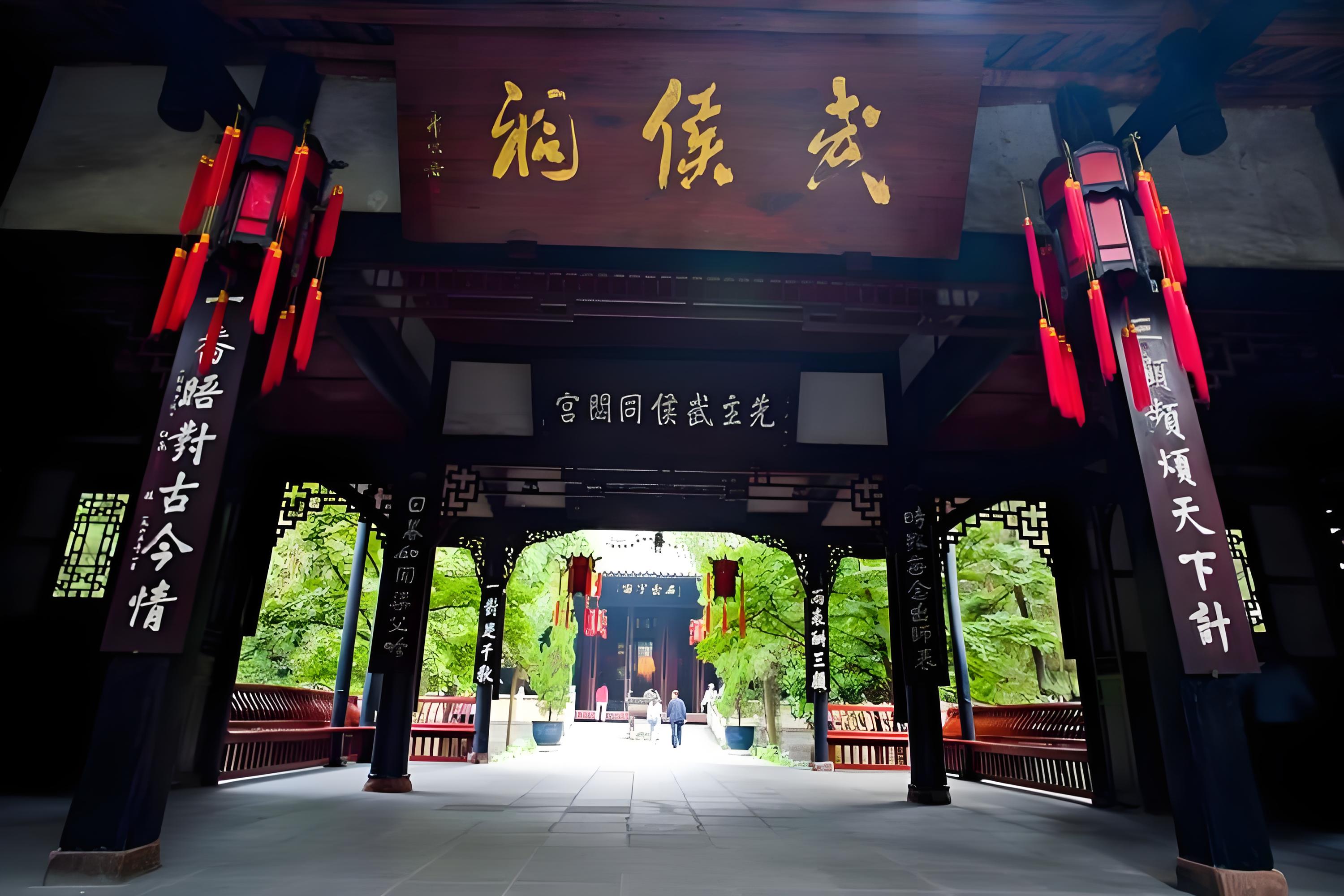
Photo: Local reference image provided for this guide.
Kuanzhai Alleys (宽窄巷子)
Kuanzhai Alleys (宽窄巷子) are a well-known pedestrian district in Qingyang District (青羊区), made up mainly of Wide Alley (宽巷子), Narrow Alley (窄巷子), and Well Alley (井巷子). The area is an easy first place to notice Chengdu's relationship with courtyards, snacks, small shops, teahouses, and slow strolling.
It can become crowded and commercial, so treat it as an introduction to Chengdu rather than the whole city. Save the Chinese name Kuanzhai Alleys (宽窄巷子), because taxi and map-app searches are more reliable with the local name.
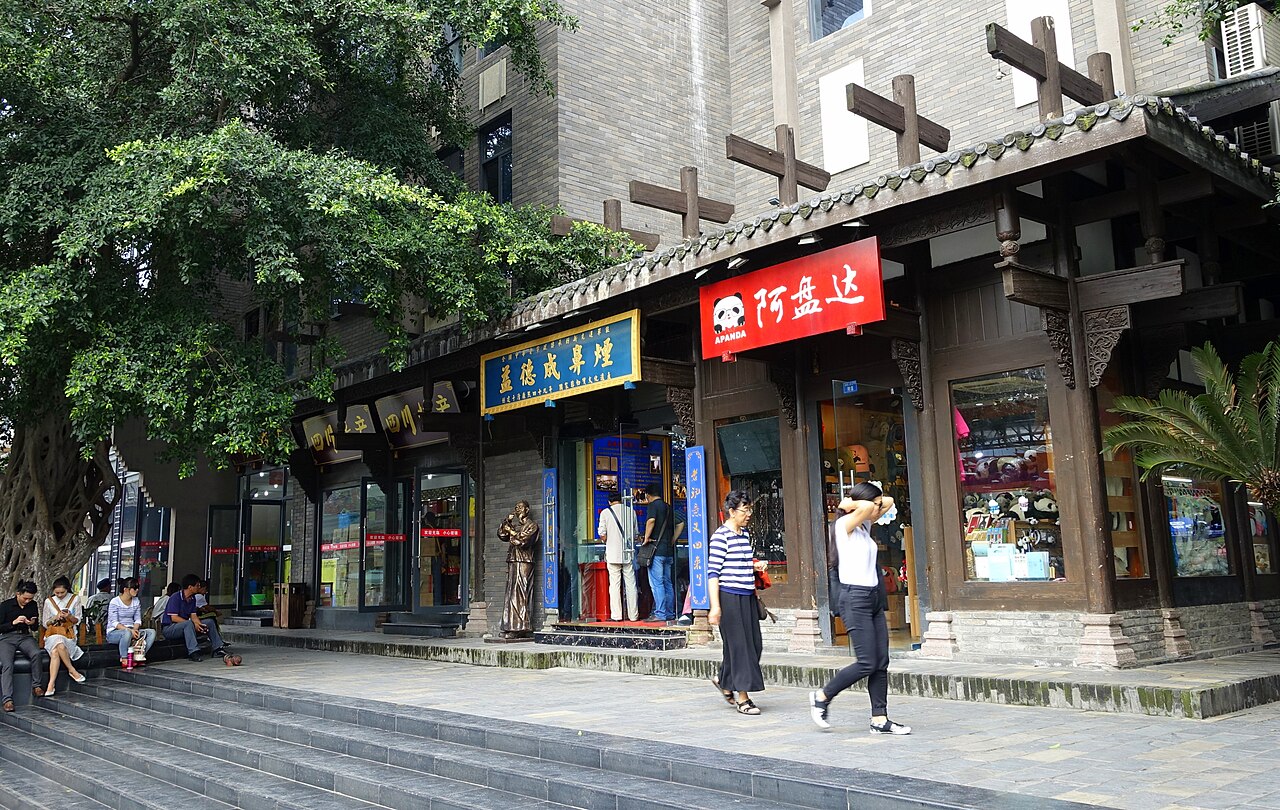
Photo: Wikimedia Commons, Daderot, open license.

Jinli Street (锦里)
Jinli Street (锦里) sits beside Chengdu Wuhou Shrine Museum (成都武侯祠博物馆). It uses western Sichuan-style architecture, narrow lanes, courtyards, bridges, snack stalls, and small shops to create an easy sensory introduction to Chengdu.
Jinli is touristy, but the pairing still works well: Jinli gives food and street atmosphere, while Wuhou Shrine gives Three Kingdoms historical context.
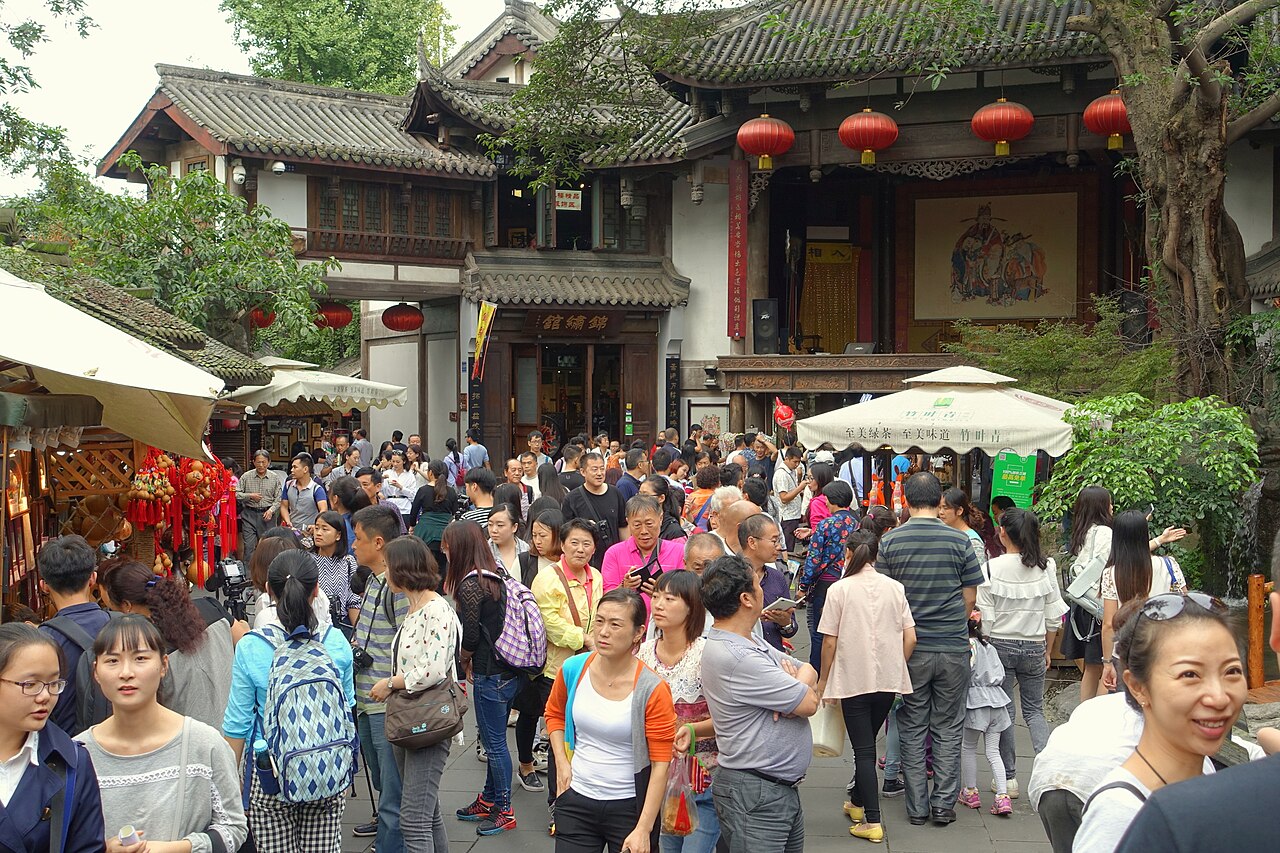
Photo: Wikimedia Commons, Daderot, open license.

Qingyang Palace (青羊宫)
Qingyang Palace (青羊宫) is located on West 2nd Section, First Ring Road, Qingyang District, Chengdu (成都市青羊区一环路西二段), beside the Jinjiang River (锦江). Known as the "First Taoist Temple of Western Sichuan" (川西第一道观) and "First Taoist Monastery of the Southwest" (西南第一丛林), it is one of Chengdu's oldest surviving Taoist temples. Tradition says it was first founded in the Zhou dynasty, and Taoist texts connect the site with Laozi (老子), making it an important place in Taoist cultural memory.
Most of the current halls were rebuilt during the Qing dynasty's Kangxi era. Today, Qingyang Palace is not only a major Quanzhen Taoist (全真派) site, but also a quiet place where local residents pray, drink tea, and take a break from the city's commercial streets.
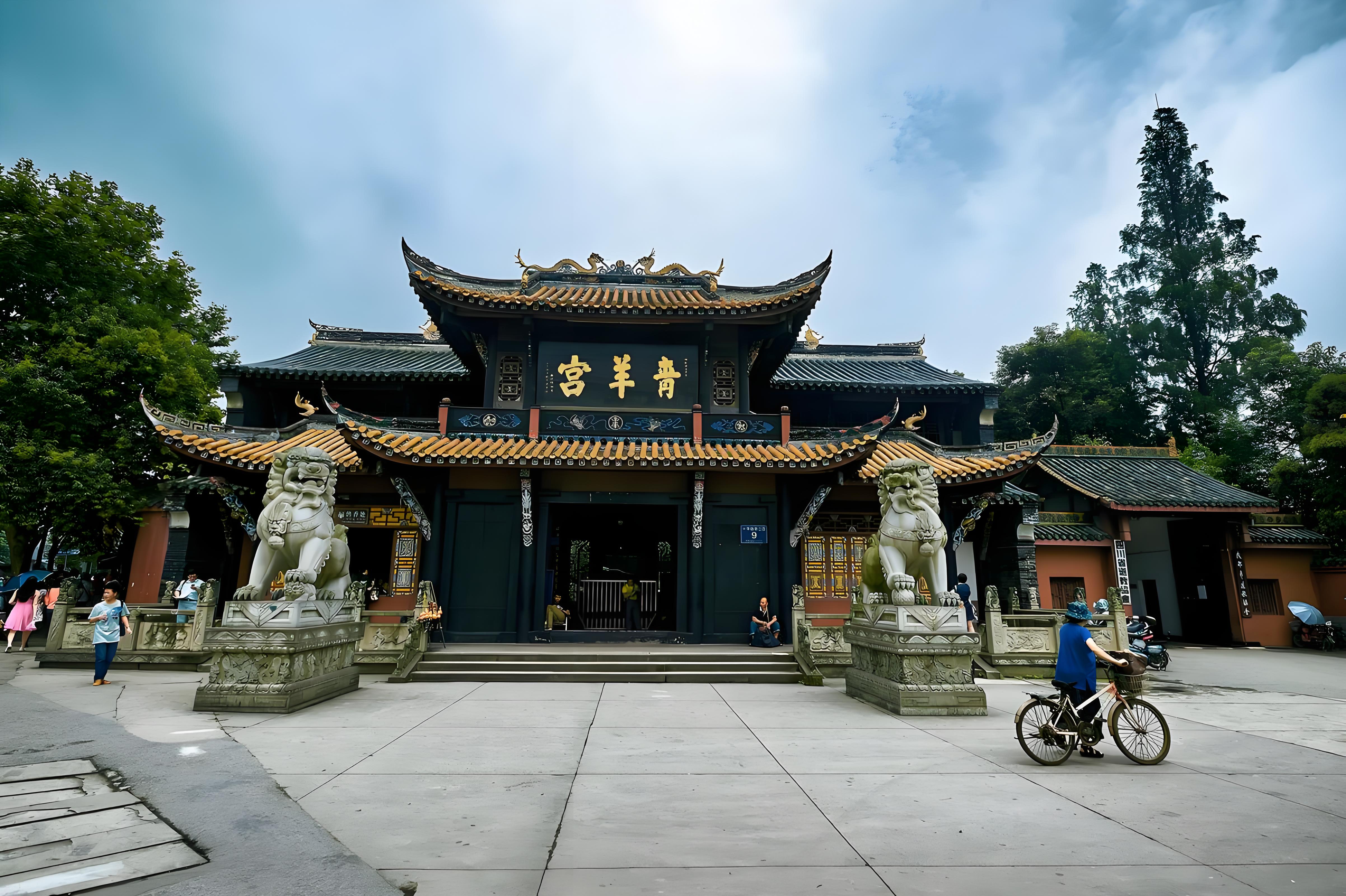
Photo: Local reference image provided for this guide.
Wenshu Monastery (文殊院)
Wenshu Monastery (文殊院) is located at No. 66 Wenshuyuan Street, Qingyang District, Chengdu (成都市青羊区文殊院街66号). It was first founded during the Sui dynasty's Daye era, around 605-617 CE, and has a history of about 1,400 years. After reconstruction during the Qing dynasty's Kangxi era, it took the name Wenshu Monastery.
The monastery covers more than 200,000 square meters, with about 11,600 square meters of buildings. It is often counted among the major Chan Buddhist temples of the Yangtze River region and is one of the best-preserved and largest Buddhist monasteries in central Chengdu.
Its collections include Buddhist relics, a skull relic associated with the monk Xuanzang (玄奘), and more than 300 Buddhist statues made from materials such as iron, lacquer, wood, stone, clay, and jade. Visit quietly and be respectful around worshippers.
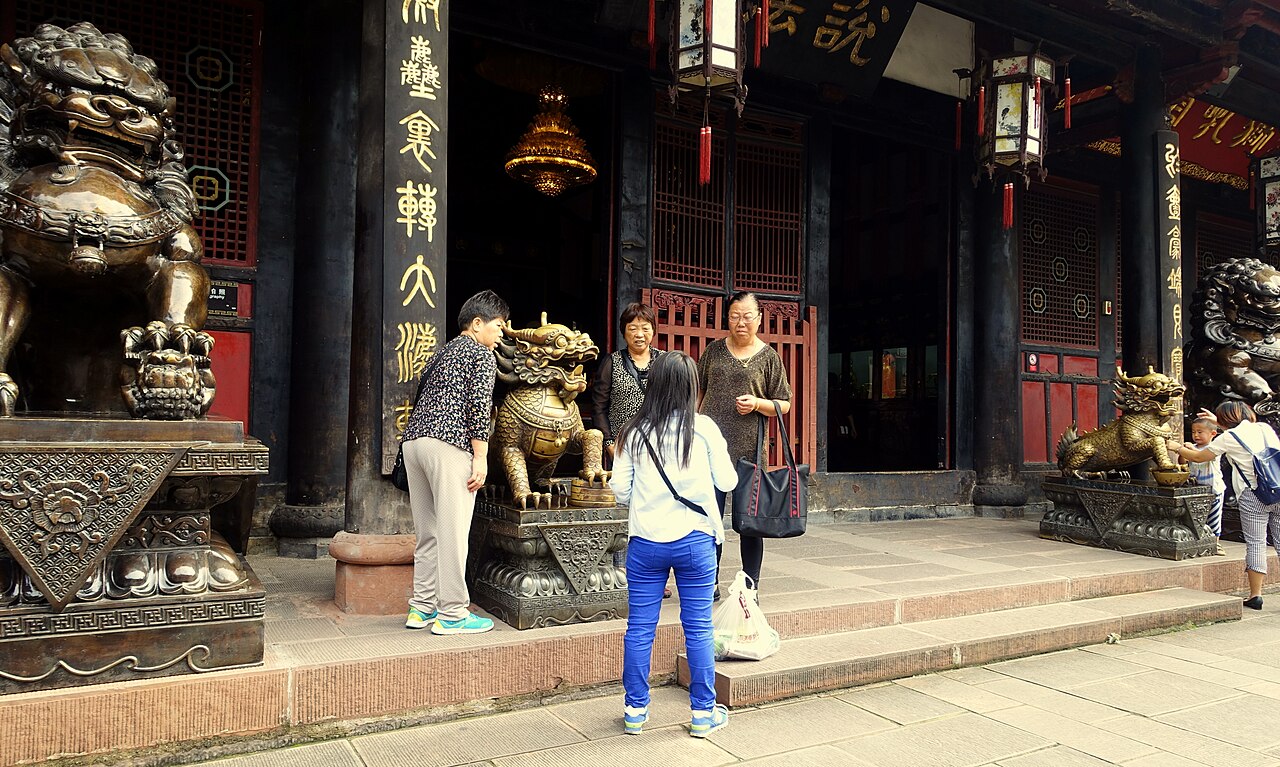
Photo: Wikimedia Commons, Daderot, open license.

Chengdu Du Fu Thatched Cottage Museum (成都杜甫草堂博物馆)
Chengdu Du Fu Thatched Cottage Museum (成都杜甫草堂博物馆) sits by Huanhua Stream (浣花溪) in Qingyang District. It preserves the memory of Du Fu (杜甫), one of the greatest poets of the Tang dynasty. In 759 CE, Du Fu fled the An Lushan Rebellion (安史之乱) and moved with his family to Sichuan. He lived here for nearly four years and wrote more than 240 poems, including Song of the Thatched Hut Broken by the Autumn Wind (《茅屋为秋风所破歌》).
The museum covers nearly 800 mu, including the protected relic zone and the Huanhuaxi area. The core buildings follow a central axis: screen wall, main gate, Daxie Hall (大廨), Hall of Poetic History (诗史堂), Chaimen Gate (柴门), and Gongbu Shrine (工部祠), with corridors and side buildings on both sides.
Highlights include the reconstructed thatched cottage, the red-wall Flower Path (花径), Wanfo Tower (万佛楼), the Tang-dynasty relics exhibition, Daya Hall (大雅堂), the Du Fu poetry calligraphy wood-carving corridor, and the Du Fu Thousand-Poem Stele (杜甫千诗碑), completed in 2018.
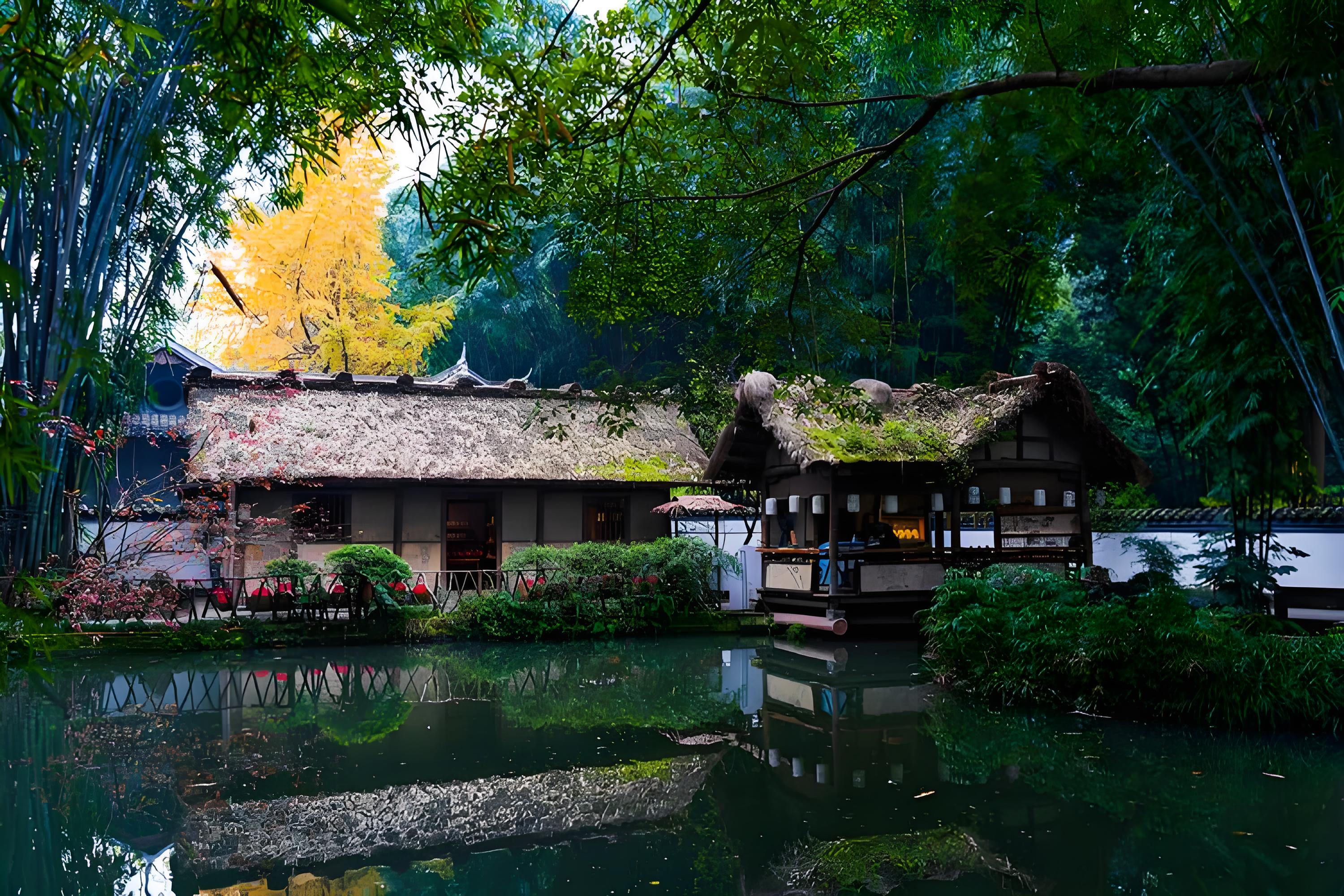
Photo: Local reference image provided for this guide.
Sanxingdui Museum (三星堆博物馆)
The Sanxingdui archaeological site (三星堆古遗址) is located on the south bank of the Yazi River (鸭子河) in Guanghan, Sichuan (四川广汉), northwest of Chengdu. Covering about 12 square kilometers, it is the largest, longest-lasting, and richest ancient city and ancient Shu cultural site found in southwest China.
Sanxingdui is often described as one of the greatest archaeological discoveries of the 20th century. It shows that the Yangtze River civilization, like the Yellow River civilization, was one of the roots of Chinese civilization.
If Chinese civilization is a grand multi-centered story, Sanxingdui is one of its most mysterious chapters. Instead of the bronze ritual vessels familiar from the Central Plains, Sanxingdui is known for striking bronze masks, unexplained symbols, thin gold masks, and a towering bronze sacred tree. The visual impact is immediate, but the deeper meaning remains fascinatingly open.
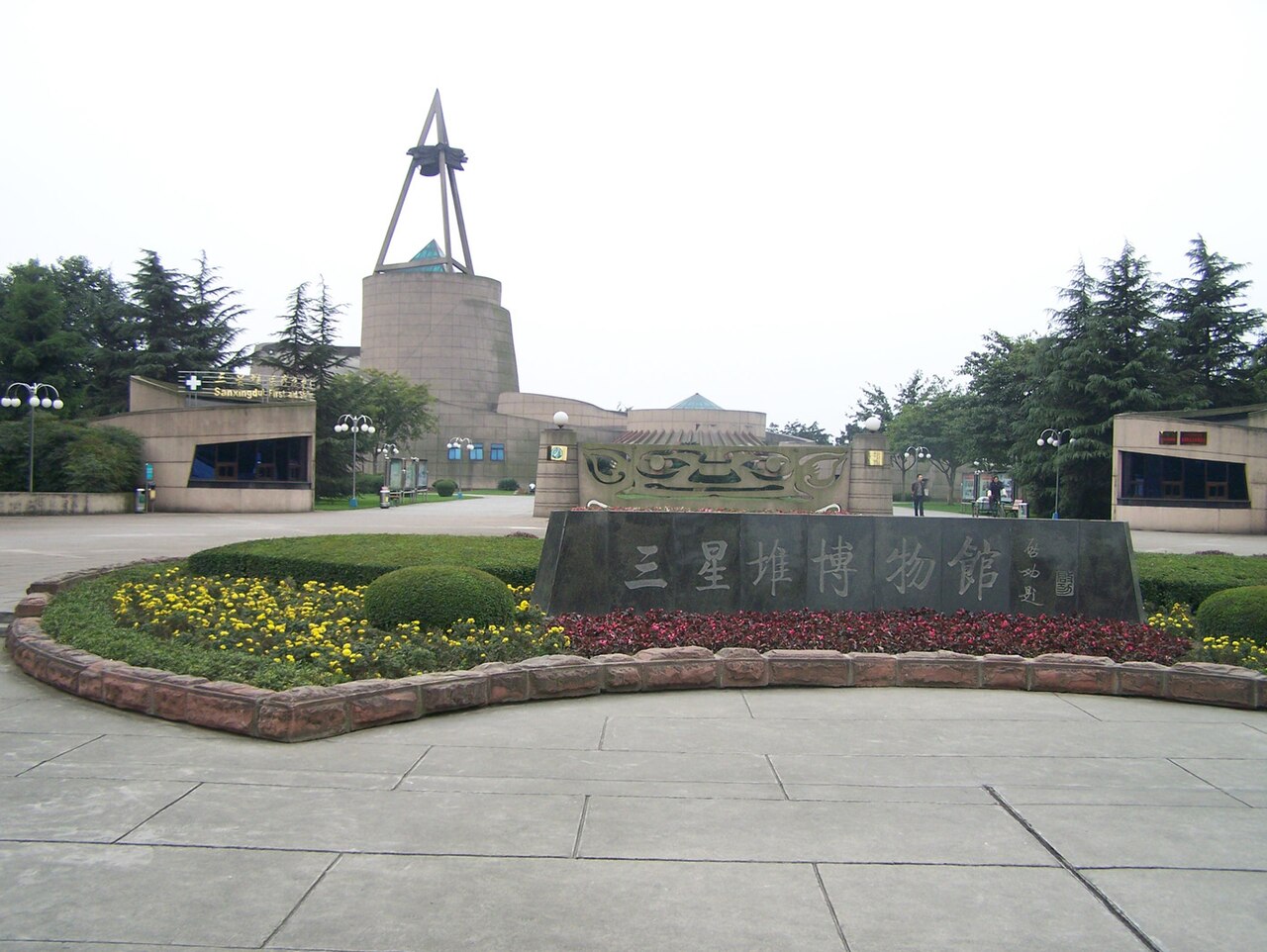
Photo: Wikimedia Commons, Jason Zou, open license.

Dujiangyan Scenic Area (都江堰景区) and Mount Qingcheng (青城山)
Dujiangyan (都江堰) is located west of Dujiangyan City, Chengdu (成都市都江堰市城西), on the Min River (岷江). It was built in 256 BCE by Li Bing (李冰), governor of Shu Commandery under the Qin state, and his son. For more than 2,200 years, it has continued to control floods and irrigate the Chengdu Plain, helping create the fertile "Land of Abundance" (天府之国).
Unlike many water projects, Dujiangyan works without a dam, using a sophisticated system of diversion, drainage, and sediment control. It is the world's oldest surviving large-scale water conservancy project of its kind and is often called the origin of world water-management culture.
In 2000, Dujiangyan was added to the UNESCO World Heritage List together with Mount Qingcheng (青城山). In 2018, it was also recognized as a World Heritage Irrigation Structure. Outside the south gate, Nanqiao Bridge (南桥) and Guanxian Ancient City (灌县古城) are convenient add-ons; after dark, the river below Nanqiao can take on a dreamy blue-light effect.
Mount Qingcheng (青城山) is closely linked with Taoist culture and pairs naturally with Dujiangyan for travelers who want both ancient engineering and mountain-temple atmosphere. The two places can be combined into one long day if you start early, but slower travelers may prefer to give each more time.
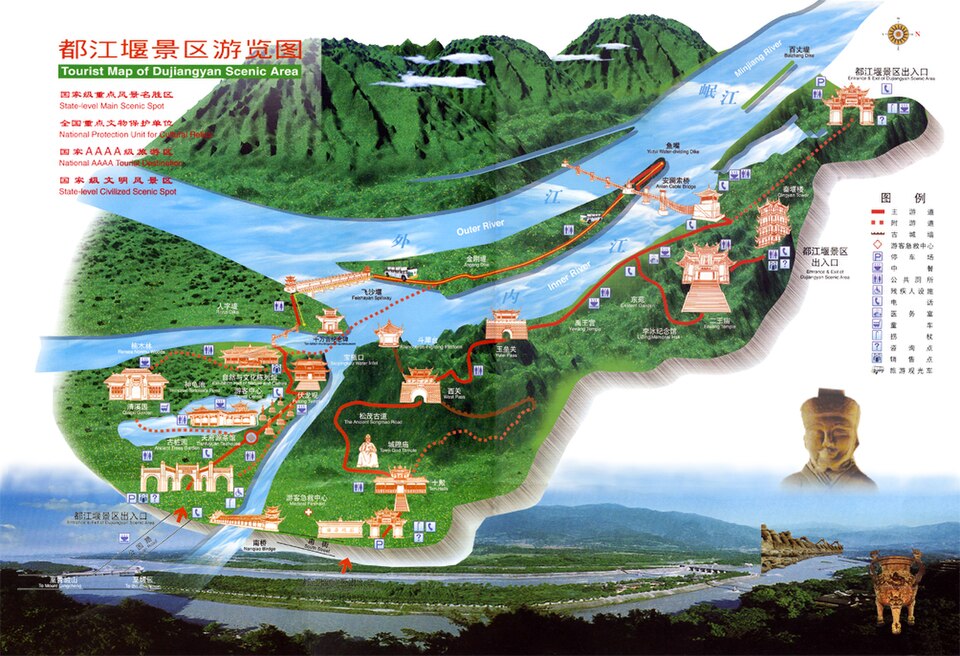
Photo: Wikimedia Commons, Ihtc2015, open license.

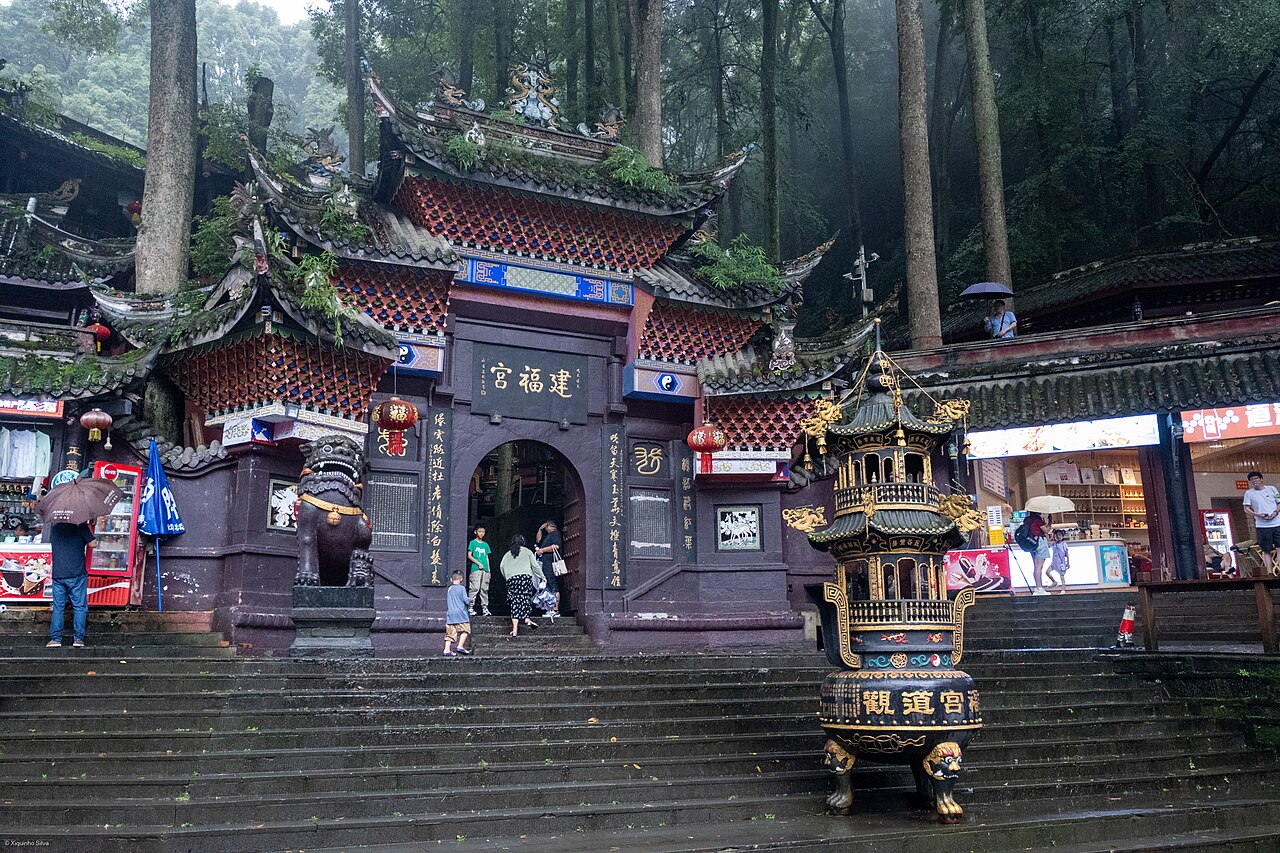
Photo: Wikimedia Commons, xiquinhosilva, open license.

Leshan and Leshan Giant Buddha Scenic Area (乐山大佛景区)
Leshan Giant Buddha (乐山大佛) is located in Leshan, Sichuan (四川乐山), where the Min River (岷江), Qingyi River (青衣江), and Dadu River (大渡河) meet. Construction began in 713 CE, the first year of the Tang dynasty's Kaiyuan era, and took about 90 years. The seated Maitreya Buddha is 71 meters high, with a 14.7-meter head, 24-meter shoulders, and 8.5-meter-wide insteps. It is the tallest and largest stone-carved seated Maitreya Buddha in the world.
The project was initiated by the monk Haitong (海通禅师). At the time, the river junction was dangerous and boats often overturned. Haitong raised labor and funds to carve the Buddha in hopes of calming the waters. After the statue was completed, the river current became gentler, and later generations revered it as a Buddha guarding the river.
The scenic area includes the Buddha itself, Lingyun Temple (凌云寺), the narrow Jiuqu Plank Road (九曲栈道) down the cliff, Mahao Cliff Tombs (麻浩崖墓), and the nearby Oriental Buddha Capital (东方佛都). In 1996, the Leshan Giant Buddha area was listed by UNESCO as part of the Mount Emei Scenic Area, including Leshan Giant Buddha Scenic Area.
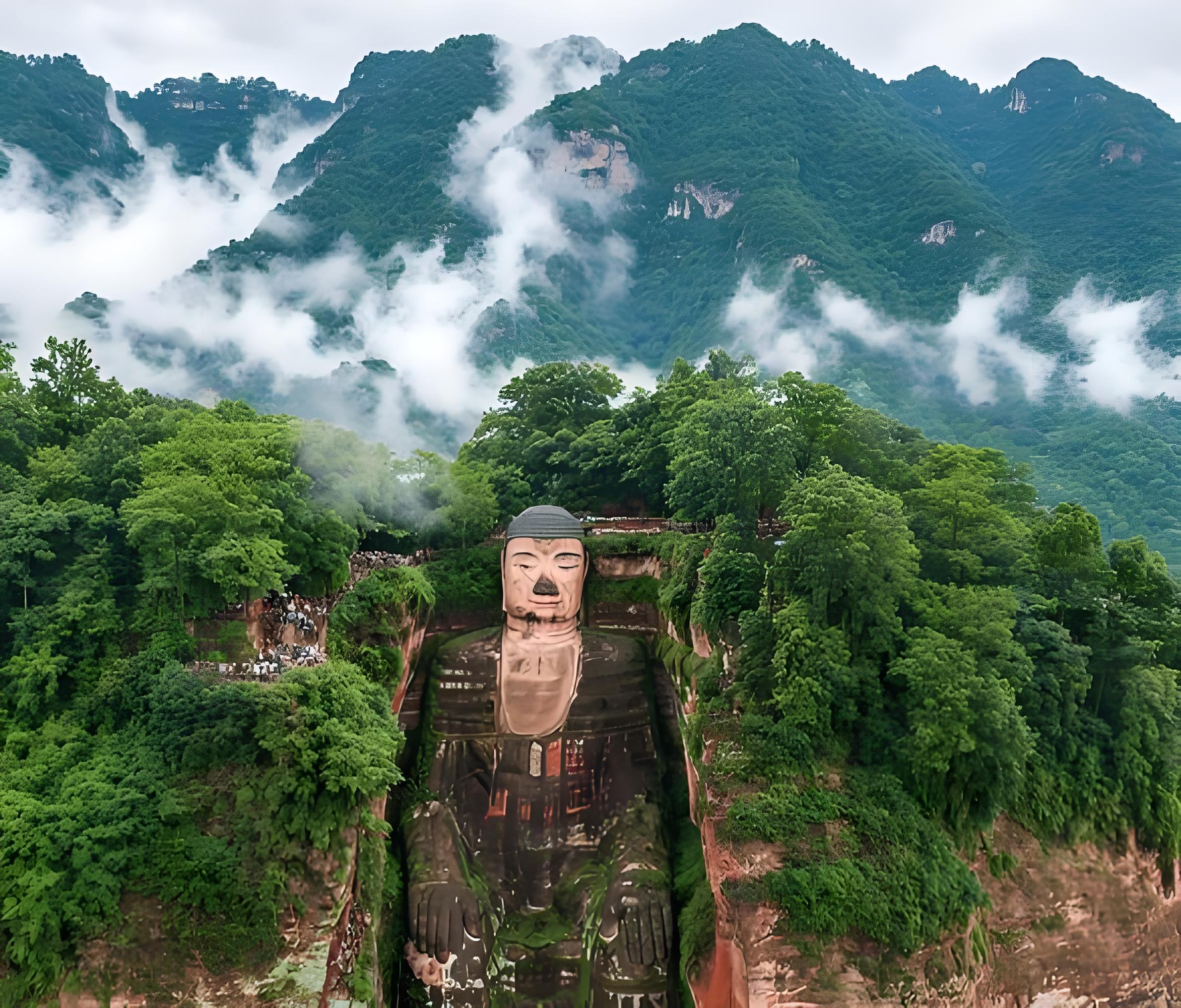
Photo: Local reference image provided for this guide.
Jiuyan Bridge (九眼桥)
The Jiuyan Bridge (九眼桥) area is located in Jinjiang District, Chengdu (成都市锦江区), along the Jinjiang River, also known historically as the Funan River (府南河). It is one of Chengdu's most attractive evening and night-view areas.
The original Jiuyan Bridge was built in 1593, during the Wanli era of the Ming dynasty, under the supervision of Sichuan provincial official Yu Yilong (余一龙). It was first named Hongji Bridge (洪济桥), but because it had nine arches, people called it Jiuyan Bridge, or "Nine-Eye Bridge." The old bridge was once an important eastbound route out of Chengdu and a busy river-transport spot.
The ancient bridge was demolished in the 1990s, and the current bridge was rebuilt in 2001 in an antique style. Although it is a reconstruction, it keeps the nine-arch form and continues Chengdu's riverfront memory.
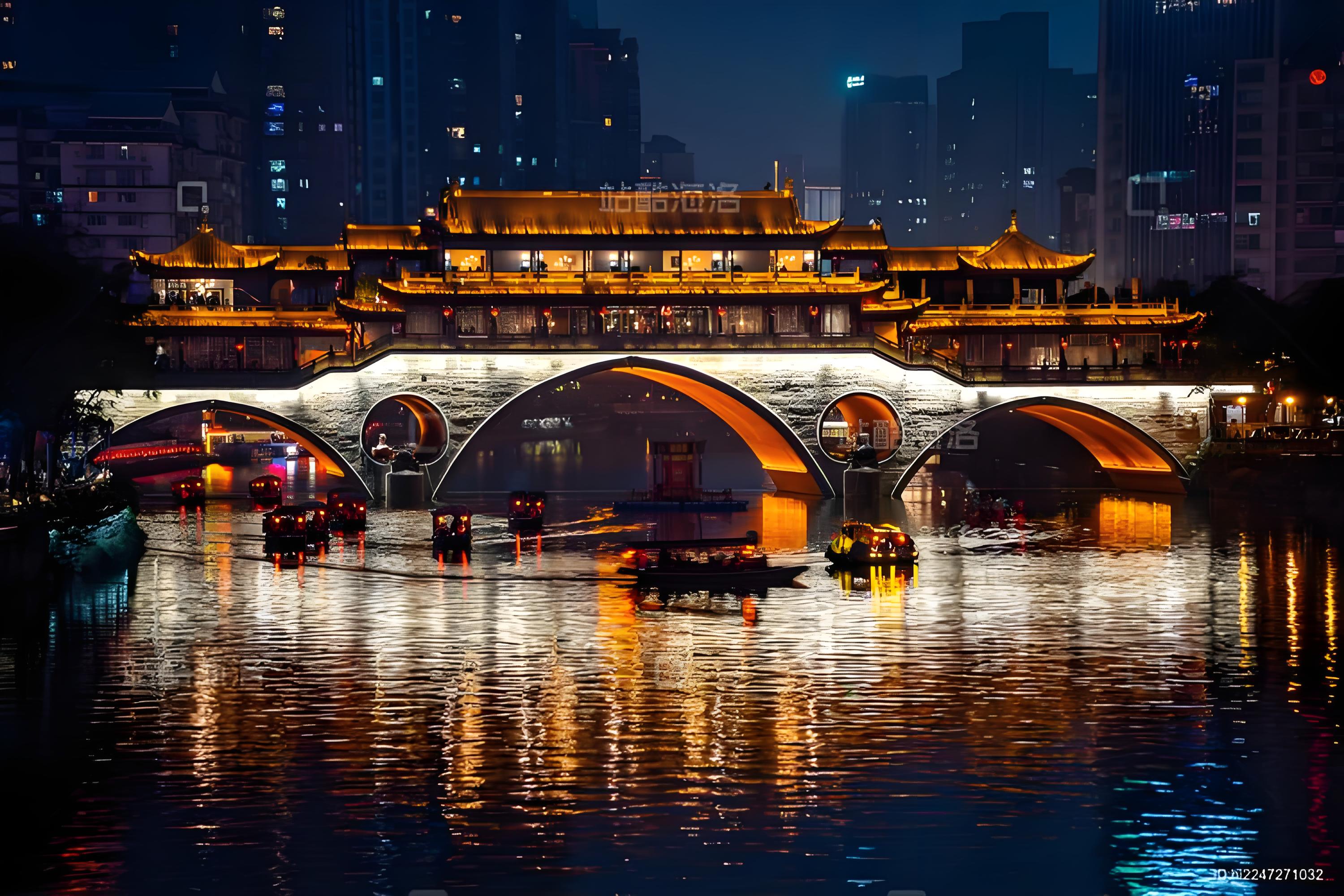
Photo: Local reference image provided for this guide.
Jiuzhaigou Valley Scenic Area (九寨沟景区)
Jiuzhaigou Valley (九寨沟) is located in Zhangzha Town, Jiuzhaigou County, Aba Tibetan and Qiang Autonomous Prefecture, Sichuan (四川省阿坝藏族羌族自治州九寨沟县漳扎镇). It is a UNESCO World Natural Heritage Site and a national 5A scenic area, famous as a "fairyland on earth" and a "fairy-tale world." Its name comes from the nine Tibetan villages once located within the valley.
Jiuzhaigou is known for five signature landscapes: turquoise lakes, layered waterfalls, colorful forests, snow peaks, and Tibetan culture. The scenic area forms a Y-shaped system made up of Shuzheng Valley (树正沟), Rize Valley (日则沟), and Zechawa Valley (则查洼沟).
Key sights include Five Flower Lake (五花海), Mirror Lake (镜海), Nuorilang Waterfall (诺日朗瀑布), Long Lake (长海), Five-Color Pond (五彩池), and the Shuzheng Lakes (树正群海). Outside the valley entrance, the show Jiuzhai Romance (《九寨千古情》) uses Tibetan and Qiang culture and Jiuzhaigou legends as its theme. In Zhangzha Town (漳扎镇), Tibetan-style hotpot, qingke barley cakes, and butter tea are also worth trying.
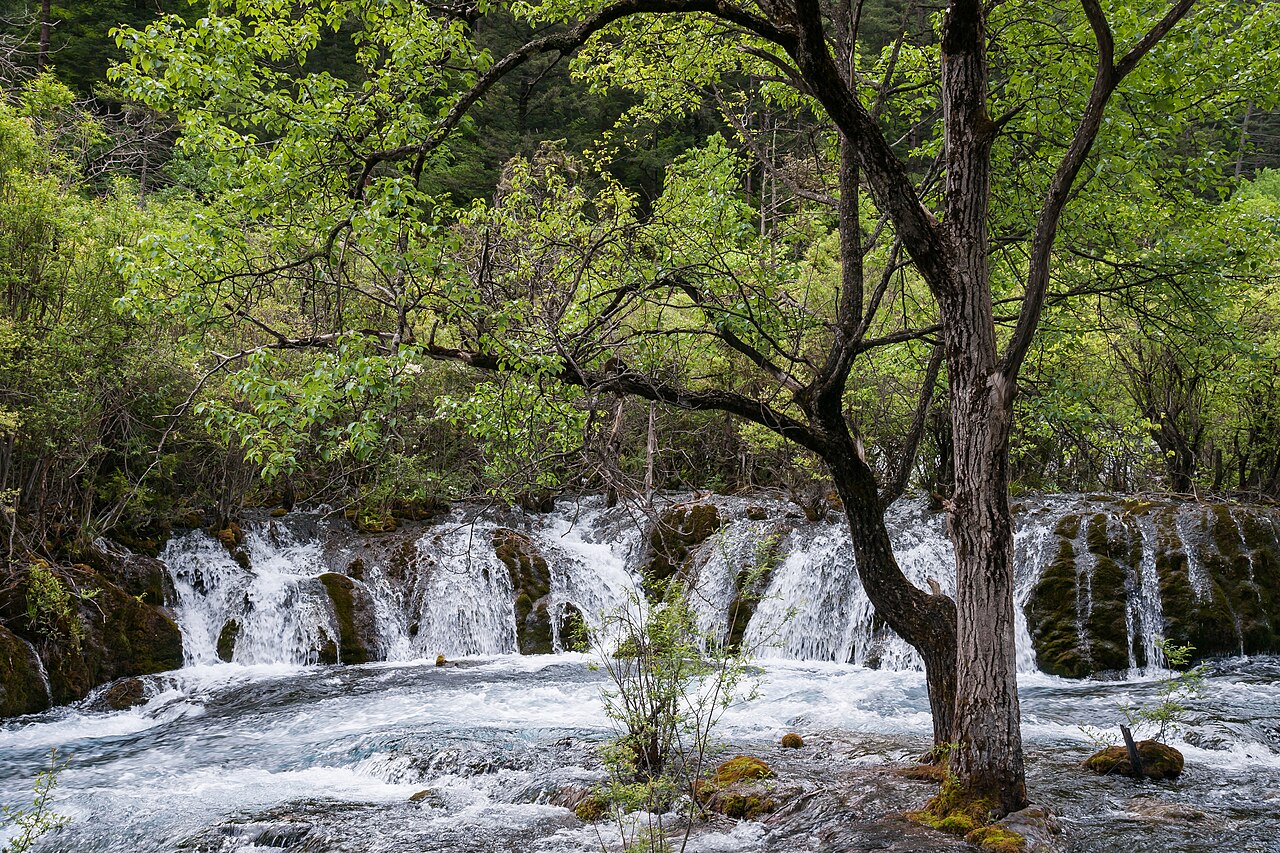
Photo: Wikimedia Commons, CEphoto, Uwe Aranas, open license.

Huanglong Scenic and Historic Interest Area (黄龙风景名胜区)
Huanglong Scenic and Historic Interest Area (黄龙风景名胜区) is located in Songpan County, Aba Tibetan and Qiang Autonomous Prefecture, Sichuan (四川省阿坝藏族羌族自治州松潘县). It is China's only well-preserved highland wetland and stretches along a ridge that rises from south to north. The scenic area covers about 700 square kilometers, with elevations from 1,700 to 5,588 meters.
Huanglong is best known for more than 3,000 colorful travertine pools. The core landscape is a giant travertine formation about 3.6 to 3.7 kilometers long, where snowmelt flows down pale yellow calcium carbonate terraces and forms layered pools in shades of yellow, green, light blue, and deep blue.
Huanglong was added to the UNESCO World Natural Heritage List in 1992 and became part of the World Network of Biosphere Reserves in 2000. In 2025, it received two more international honors, including entry onto the IUCN Green List as China's first protected area certified under that status as a World Heritage site.
The highlight is Five-Color Pond (五彩池) near the top of the main valley. Covering about 21,000 square meters and containing 693 pools, it is often called a "heavenly jade pool on earth" (人间瑶池).
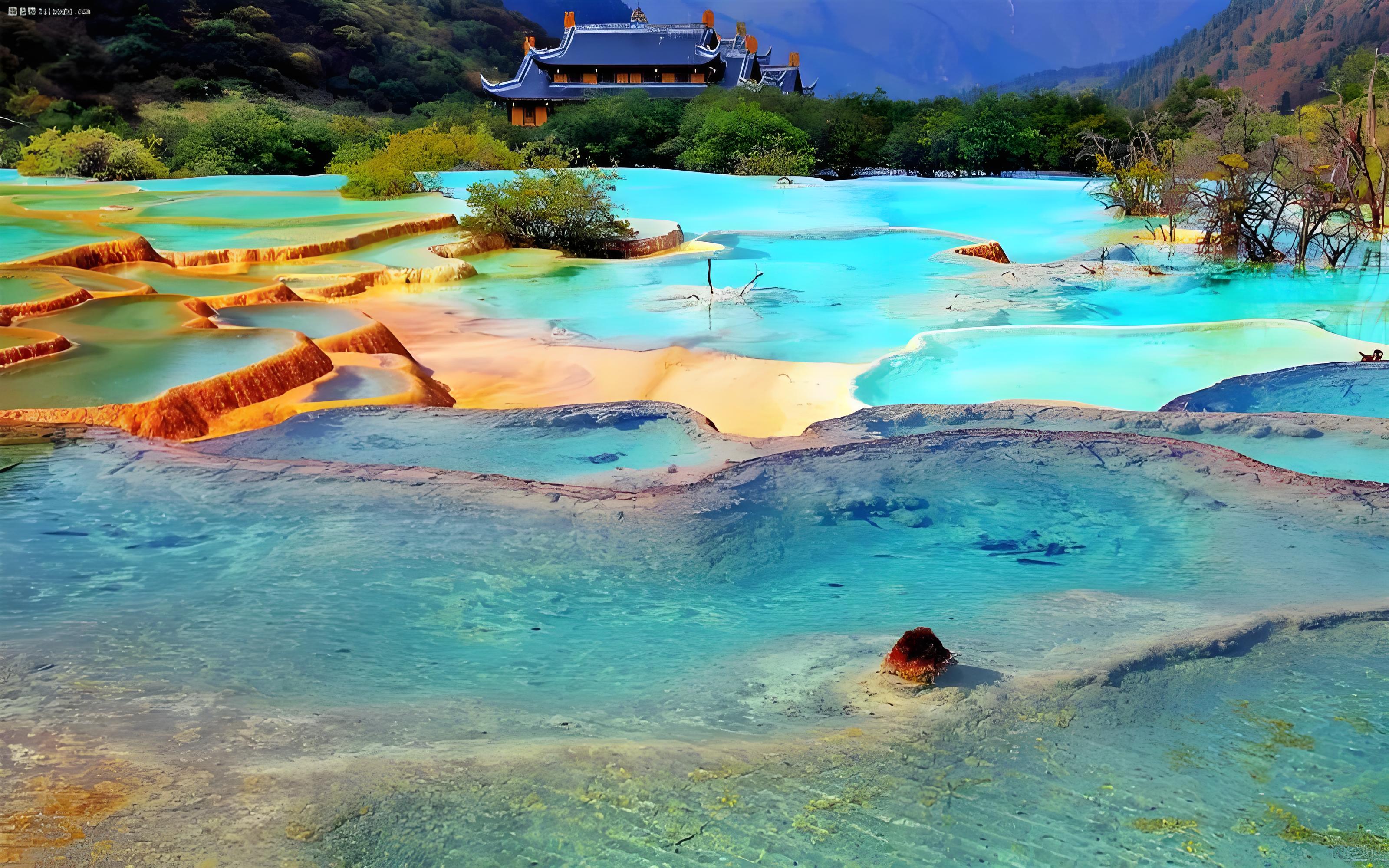
Photo: Local reference image provided for this guide.
Food notes
Sichuan food is a reason to visit, but you do not have to begin with the hottest possible dish. Kuanzhai Alley and Jinli are convenient but touristy; local restaurants near residential areas can be better once your payment and translation setup feels stable.
Hotpot
Hotpot is a shared meal where raw ingredients are cooked in a simmering pot, often with chili oil and Sichuan peppercorn. Start with a mild or split pot if you are unsure.
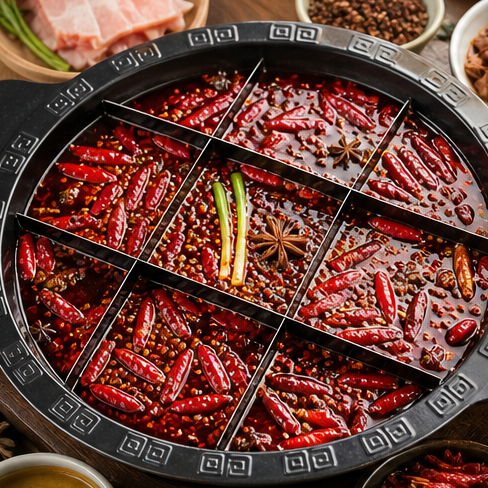
Image: AI-generated local food photograph, no brand or identifiable shop.
Chuanchuan
Chuanchuan is similar in spirit to hotpot, but ingredients come on skewers. It is usually more casual and flexible.
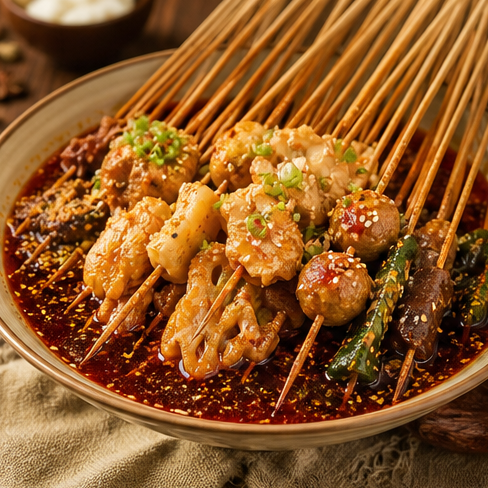
Image: AI-generated local food photograph, no brand or identifiable shop.
Dandan noodles
Dandan noodles are small bowls of noodles with chili oil, minced meat, preserved vegetables, and a nutty or sesame-like richness depending on the shop.
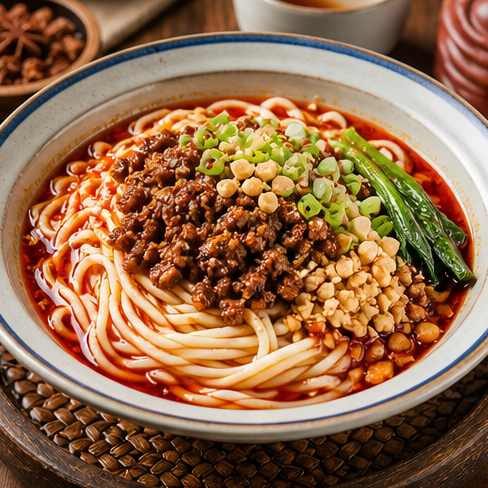
Image: AI-generated local food photograph, no brand or identifiable shop.
Zhong dumplings
Zhong dumplings are dumplings dressed in a sweet, garlicky, chili-oil sauce.
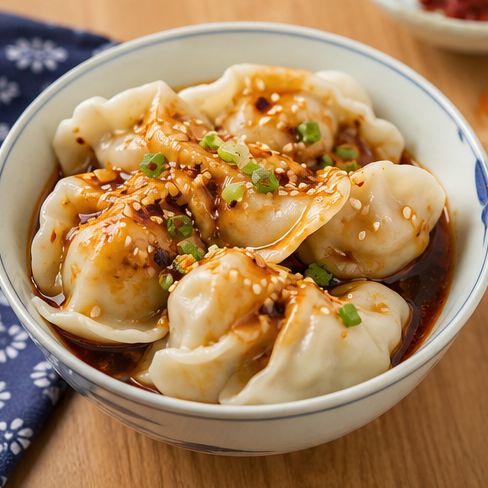
Image: AI-generated local food photograph, no brand or identifiable shop.
Mapo tofu
Mapo tofu is tofu in a spicy bean-paste sauce with minced meat and numbing peppercorn.
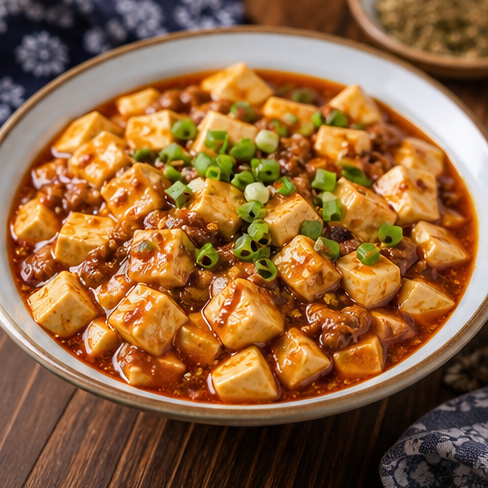
Image: AI-generated local food photograph, no brand or identifiable shop.
Read How to Order Food in China Without Speaking Chinese.
Practical Tips
- Start panda-base day early and check official ticketing before departure.
- Leave space for tea, snacks, and a slower afternoon.
- Expect popular pedestrian streets to become crowded.
- Keep your hotel address and ride-hailing destination in Chinese.
- Use Chengdu as a base for nearby trips only after your city days feel comfortable.
- Keep one quiet tea-house or park stop in the plan; Chengdu's slower rhythm is part of the destination.
Chengdu Orientation Map
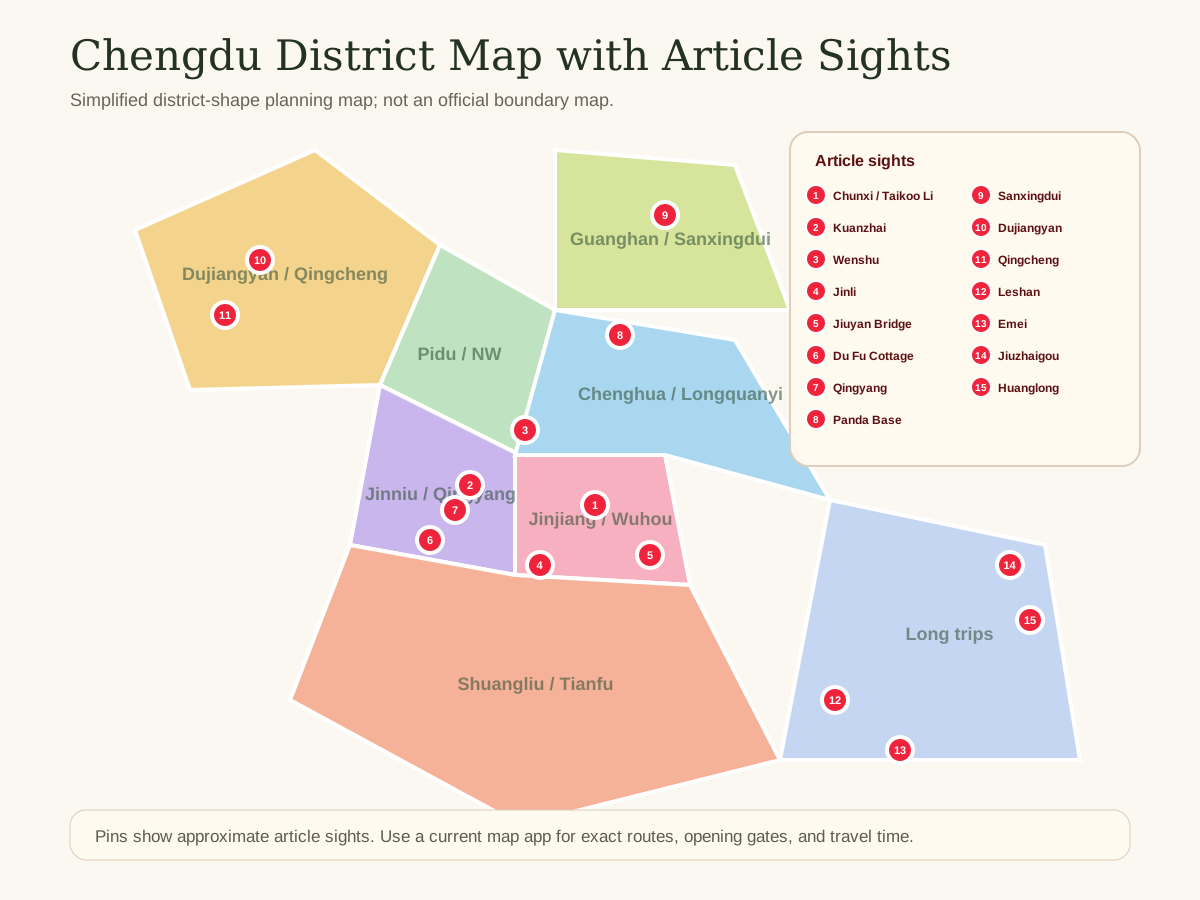
This is a planning map, not a navigation map. It groups the article's sights by rough area so travelers can judge which places are easy to combine in the same day.
Related Reading
Booking PDFs
Chengdu booking guides
Start with the complete city bundle, or choose only the single-attraction PDF you need.
Full city bundle
Chengdu Attraction Booking Process Bundle
All 11 Chengdu and Sichuan attraction booking-process PDFs in one combined guide.
Need only one attraction instead?
Choose a single booking PDF only when one attraction is the immediate priority.
Chengdu Panda Base Booking Guide
Passport, real-name booking, time-slot, sightseeing-bus, Panda Tower, and early-arrival notes.
$0.99
Get PDFKuanzhai Alleys Chengdu Guide
Free-street access, crowd-control, metro, tea-house, food, and photography notes.
$0.99
Get PDFWuhou Shrine Booking Guide
Official WeChat booking, passport, timed entry, Jinli pairing, and Three Kingdoms route notes.
$0.99
Get PDFDu Fu Thatched Cottage Booking Guide
14-day booking window, passport, ticket pickup, poetry-site route, and photo timing notes.
$0.99
Get PDFQingyang Palace Chengdu Guide
No-reservation temple ticket, on-site purchase, metro, etiquette, tea-garden, and scam-avoidance notes.
$0.99
Get PDFDujiangyan Booking Guide
Real-name booking, passport, time slots, south-gate route, Nanqiao evening, and transit notes.
$0.99
Get PDFLeshan Giant Buddha Booking Guide
Mountain ticket, boat ticket, passport, time-slot, manual-entry, and day-trip planning notes.
$0.99
Get PDFSanxingdui Museum Booking Guide
5-day booking window, 20:00 release time, passport, official channels, and exhibit-route notes.
$0.99
Get PDFWenshu Monastery Chengdu Guide
Free-entry temple access, Lunar New Year reservation caution, metro, tea, vegetarian food, and etiquette notes.
$0.99
Get PDFJiuyan Bridge Chengdu Guide
Free night-view route, Anshun Bridge distinction, metro, bar-street caution, and photo timing notes.
$0.99
Get PDFJiuzhaigou and Huanglong Booking Guide
Passport, official platforms, time windows, train-transfer notes, high-altitude caution, and Huanglong cable-car pricing.
$0.99
Get PDFNext step
Need city booking help after choosing your route?
Compare city booking bundles for attraction reservations, passport-user notes, official-platform reminders, and day-of-entry checks.
Sources and reference checks
- https://www.gochengdu.cn/en/article/food/304
- https://www.gochengdu.cn/article/happy_life_in_chengdu/4586
- https://www.gochengdu.cn/en/article/around_chengdu/858
- https://file.gochengdu.cn/file/20230418/72d8a7cf129f5d5027a132a6c7af3d93.pdf
- https://english.www.gov.cn/news/photos/202008/11/content_WS5f31fba4c6d029c1c26378dc.html
Conversation
Questions and comments
Share a question, correction, or reading note. Most comments appear automatically. Some are held briefly for review.
Need a private reply? Email chiyaoyaoya@gmail.com.
Loading comments...